
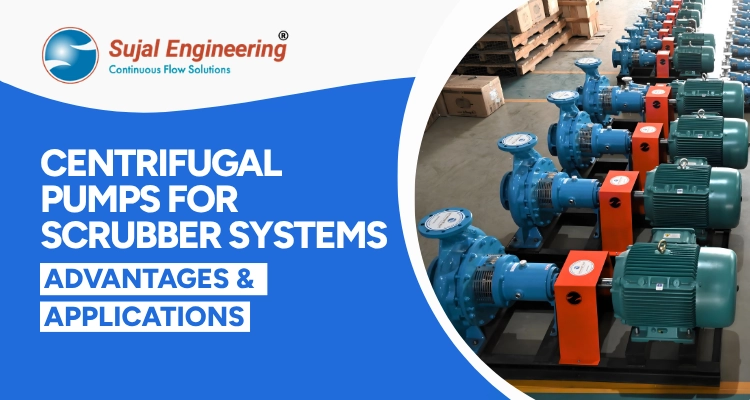
Centrifugal Pumps for Scrubber Systems – Advantages & Applications
If your scrubber system is struggling with poor circulation, chemical corrosion, or frequent pump failures the pump you choose is either the problem or the solution.
Centrifugal pumps are the industry-standard choice for wet scrubber systems because they deliver continuous, high-volume fluid flow with low maintenance requirements even when handling corrosive acids, alkaline solutions, and abrasive slurries.
At Sujal Pumps, we engineer centrifugal pumps purpose-built for the harsh, corrosive, and high flow demands of industrial scrubber systems. Whether you operate a chemical plant in Gujarat, a power station in Maharashtra, or a pharmaceutical unit supplying global markets choosing the right scrubber pump directly impacts your emission control compliance, uptime, and operating costs.
This guide covers everything you need to know what centrifugal pumps do in scrubbers, why they outperform alternatives, which pump types of suit which applications, and how to select the right model for your facility.
What Is a Wet Scrubber System – and Why Does the Pump Matter?
A wet scrubber is an air pollution control device that removes harmful gases, particulates, and chemical contaminants from industrial exhaust streams. It works by passing polluted gas through a liquid usually water, an acid solution, or an alkaline slurry which absorbs or neutralizes the pollutants before the cleaned gas exits the stack.
The scrubber pump is the heart of this process. It continuously circulates the scrubbing liquid from the sump or tank, sprays it into the gas stream inside the scrubber tower, and returns the spent liquid for treatment or recirculation. Without a reliable, high-flow pump, the entire system underperforms leading to regulatory non-compliance, equipment corrosion, and process downtime.
In a wet scrubber, pump failure = emission control failure. That’s why pump material, flow capacity, and corrosion resistance are non-negotiable specifications.
Why Are Centrifugal Pumps the Preferred Choice for Scrubber Systems?
Centrifugal pumps dominate scrubber system installations across industries for several concrete reasons:
- Continuous, uninterrupted flow: Scrubbers need steady liquid circulation, not intermittent pulses
- High flow rate capability: Centrifugal pumps handle large volumes efficiently, matching the high liquid demand of industrial scrubbers
- Simple design with few moving parts: Results in lower maintenance frequency and reduced downtime
- Available in corrosion-resistant materials: PP (Polypropylene), PVDF, SS 316L, and FRP to handle acids, alkalis, and solvents
- Self-regulating performance: Centrifugal pumps adjust naturally to system resistance changes
- Wide operating range: Suitable for clean liquids, mild slurries, and chemically aggressive fluids
Compared to positive displacement pumps, centrifugal pumps are better suited for the large, variable flow rates that scrubbers demand especially in continuous-process industries like chemical manufacturing, power generation, and wastewater treatment.
What Are the Key Advantages of Centrifugal Pumps in Scrubber Systems?
1. Corrosion Resistance for Chemical Environments
Scrubber liquids are almost always chemically aggressive HCl, H₂SO₄, NaOH, chlorinated compounds, and acidic condensates. Using a standard cast iron or carbon steel pump in these environments leads to rapid corrosion, metal contamination of the scrubbing liquid, and costly replacements.
Centrifugal process pumps made from PP (Polypropylene) and PVDF (Polyvinylidene Fluoride) are chemically inert to most acids and alkalis. This material advantage translates directly into longer service life, lower total cost of ownership, and zero risk of metal contamination in food, pharma, or potable water applications.
2. High Hydraulic Efficiency for Large-Scale Circulation
Industrial scrubber towers especially those used in flue gas desulfurization (FGD) in power plants require pumps that can move tens of thousands of liters per hour continuously. Centrifugal pumps achieve this with impressive hydraulic efficiency, consuming less energy per unit of liquid moved than most alternatives.
For large-scale scrubber systems, high-efficiency centrifugal process pumps reduce electricity consumption significantly a key factor for plants running 24/7 operations.
3. Low Maintenance and High Availability
Because centrifugal pumps have a simple impeller-based mechanism with no valves or pistons, they require minimal scheduled maintenance. Mechanical seals, bearings, and impellers are the main wear components and in a well-specified pump, these have long service intervals.
This is critical for industries where scrubber systems must operate continuously cement plants, chemical reactors, pharmaceutical manufacturing, and power stations cannot afford prolonged maintenance shutdowns.
4. Slurry and Particulate Handling Capability
Scrubber liquids are not always clean water. In mining, cement, and FGD applications, the circulating liquid contains significant suspended solids calcium sulphate, fly ash, metal oxides, and particulate matter absorbed from the gas stream.
Centrifugal pumps with open impeller designs and anti-clogging geometry handle slurry without jamming. This makes them ideal as scrubber slurry handling pumps where solids content regularly exceeds 5–15% by weight.
5. Flexible Installation Options
Scrubber systems come in many configurations floor-mounted sumps, elevated tanks, below-grade pits, and pressurized vessels. Centrifugal pumps are available in horizontal, vertical, and submersible configurations, making them adaptable to virtually any installation layout.
Which Types of Centrifugal Pumps Are Used in Scrubber Systems?
Not all centrifugal pumps are created equally. Here is the key pump types used in scrubber applications, along with their best-fit use cases.
1. Centrifugal Process Pumps
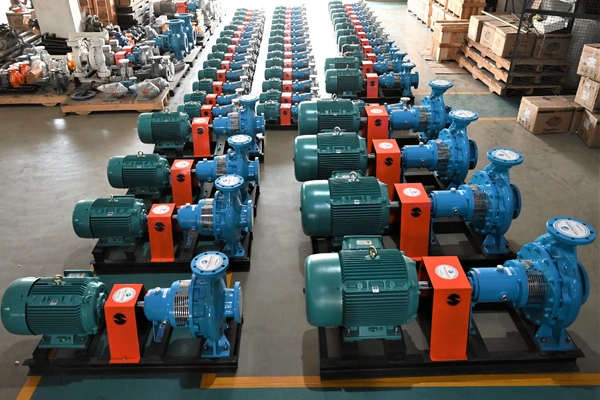
The workhorse of industrial scrubber systems. Sujal’s Centrifugal Process Pumps are designed for continuous circulation of corrosive and moderately viscous liquids. Available in back-pull-out design for easy maintenance, they handle flow rates from a few hundred LPH to several lakh LPH depending on impeller size and motor configuration.
Best for: Chemical scrubbers, pharmaceutical vent gas scrubbers, acid mist scrubbers, alkaline scrubbers.
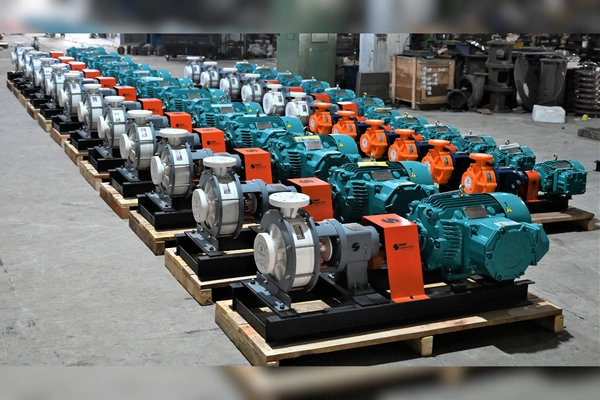
2. Polypropylene (PP) Pumps
PP monoblock pumps and PP centrifugal pumps are the go-to choice for handling dilute acids, alkaline solutions, and chlorinated liquids in scrubber circulation loops. Their all-PP wetted construction ensures zero metal contamination and excellent resistance to HCl, HNO₃, and H₂SO₄ at moderate concentrations.
Sujal’s Polypropylene Monoblock Pumps and Polypropylene Pumps are widely used in chemical processing, electroplating, and textile dyeing scrubbers where acid mist control is essential.
Best for: Acid fume scrubbers, electroplating exhaust treatment, textile dyeing plants, fertilizer plants.
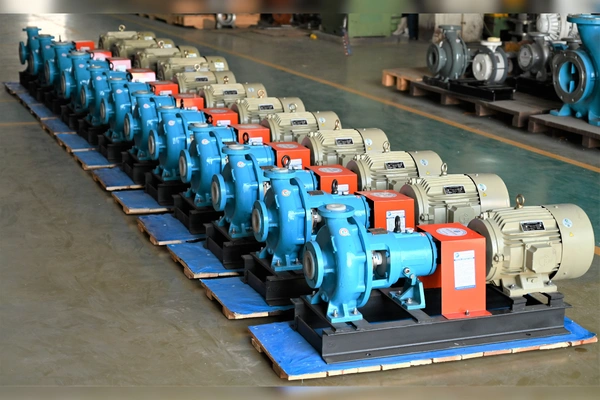
3. PVDF Pumps
When concentrations are high and temperatures are elevated, PVDF (Polyvinylidene Fluoride) pumps are the material of choice. PVDF offers superior chemical resistance compared to PP withstanding concentrated acids including HF (hydrofluoric acid), strong oxidizing agents, and hot process liquids up to 120°C.
Sujal’s PVDF Pump range is specifically engineered for the most demanding chemical scrubber applications pharmaceutical solvent recovery scrubbers, semiconductor fab exhaust treatment, and aggressive chemical plant vent systems.
Best for: Concentrated acid scrubbers, pharmaceutical API scrubbers, HF handling, chlorine gas scrubbers.
4. Vertical Long Shaft Sump Pumps
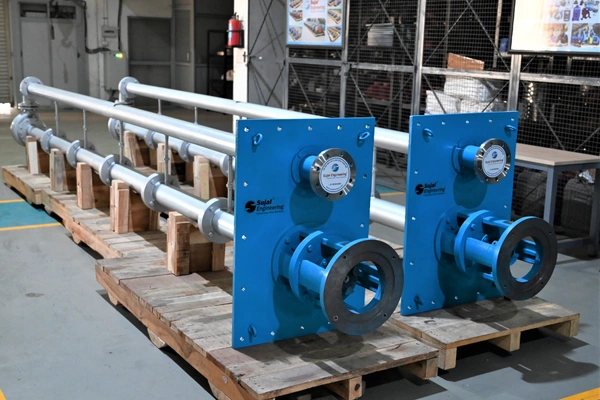
Scrubber sumps up the collection of tanks at the base of scrubber towers that are often deep, underground, or difficult to access. Sujal’s Vertical Long Shaft Sump Pumps are designed to sit below the liquid level without a mechanical seal on the shaft, eliminating seal-related failures common in corrosive sump environments.
These pumps use an extended shaft that brings the motor above the liquid surface, combining the efficiency of a centrifugal impeller with the installation practicality of a vertical sump configuration.
Best for: FGD scrubber sumps, chemical plant collection pits, wastewater scrubber sumps, large industrial scrubber tanks.
5. Self-Priming Mud Pumps (SMSP / SMP Series)
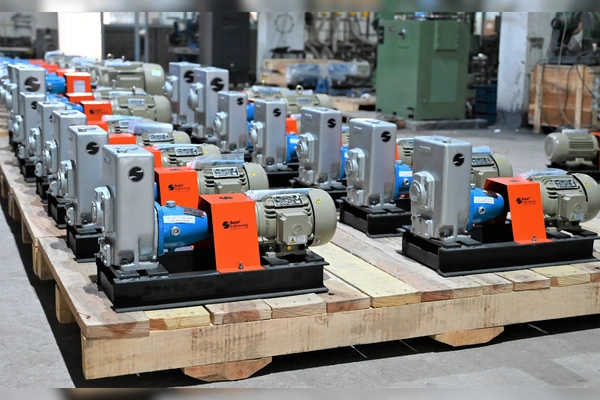
In applications where the scrubber sump is located below the pump or where solid-laden slurry needs to be transferred periodically, self-priming capability becomes essential. Sujal’s SMSP (Self-Priming Mud Pump) and SMP Series Self-Priming Mud Pump handle solids up to 50mm and can self-prime up to 6–7 meters suction lift.
These pumps are particularly useful for scrubber blowdown transfer, sludge removal from scrubber collection tanks, and intermittent solids-laden liquid transfer where a non-self-priming pump would cavitate and fail.
Best for: FGD scrubber blowdown, scrubber sludge handling, lime slurry transfer in wet scrubbers.
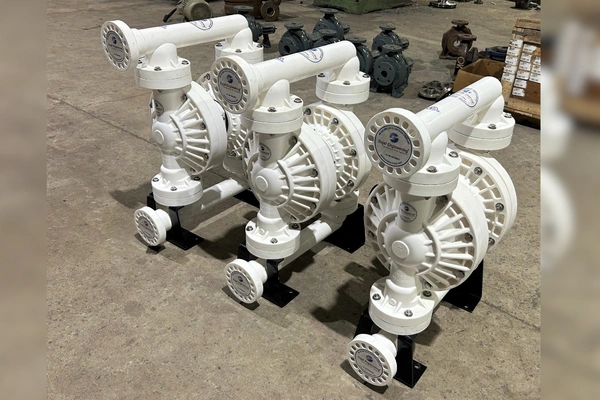
6. Air-Operated Double Diaphragm (AODD) Pumps
For scrubber systems that require metered dosing of neutralizing agents (lime, caustic soda, sodium bicarbonate), Sujal’s Polypropylene Air Operated Diaphragm Pump and Stainless Steel AODD Pump provide pulsation-controlled, seal-free liquid transfer.
AODD pumps are also valuable during scrubber shutdown sequences where system pressures drop, and gravity drainage is insufficient. Their ability to run dry without damage makes them ideal for backup or auxiliary transfer pumps.
Best for: Reagent dosing in scrubbers, caustic transfer, viscous slurry transfer, scrubber startup/shutdown sequences.
Comparison: Centrifugal Pump Types for Scrubber Applications
Pump Type | Best Fluid Type | Key Advantage | Typical Application | Material |
Centrifugal Process Pump | Aqueous corrosive liquids | High flow, low-viscosity efficiency | Chemical / Pharma scrubbers | PP, PVDF, SS316L |
PP Monoblock Pump | Dilute acids & alkalis | Chemical inertness | Acid fume scrubbers | Polypropylene |
PVDF Pump | Concentrated acids, HF, oxidizers | Ultra-high chemical resistance | Pharma API, semiconductor | PVDF |
Vertical Long Shaft Sump Pump | Corrosive liquids in sumps | No shaft seal needed | FGD sump, deep pits | PP, SS, CI |
Self-Priming Mud Pump | Slurry with solids | Handles solids, self-primes | FGD blowdown, sludge removal | CI, SS, Rubber-lined |
AODD Pump | Viscous, shear-sensitive fluids | No seals, dry-run safe | Reagent dosing, transfer | PP, SS, PVDF |
Where Are Centrifugal Scrubber Pumps Used? Industry-Wise Applications
Chemical & Petrochemical Plants
Chemical plants generate HCl, HNO₃, H₂SO₄, Cl₂, and SO₂ fumes that must be scrubbed before atmospheric release. Centrifugal process pumps and PVDF pumps circulate scrubbing liquids typically water, caustic soda, or sodium hypochlorite through packed-bed or venturi scrubbers continuously.
Application examples: Chlorine scrubbers, acid recovery scrubbers, solvent recovery systems, ammonia scrubbers.
Power Plants & Flue Gas Desulfurization (FGD)
Coal-fired power plants use wet limestone scrubbers to remove SO₂ from flue gases. These FGD systems require enormous pump capacities often 500–5,000 m³/hr to circulate limestone slurry through the absorber tower.
Vertical long shaft sump pumps and heavy-duty horizontal centrifugal pumps with wear-resistant impellers are the workhorses here. Self-priming mud pumps handle the calcium sulphate slurry blowdown from the absorber sump.
Pharmaceutical & API Manufacturing
Pharmaceutical scrubbers handle reactive, high-purity solvents, HCl off-gases, and organic vapours from reaction vessels. The pump must be FDA-compatible, introduce zero contamination, and handle aggressive chemicals without degradation.
PVDF pumps and SS316L centrifugal process pumps are specified for pharmaceutical scrubber loops, where material traceability and chemical inertness are regulatory requirements.
Mining & Cement Industry
Cement kilns and mining operations generate dust, SO₂, and NOx that must be controlled. Scrubber systems in these plants deal with highly abrasive slurries calcium oxide, silica dust, fly ash.
Rubber-lined centrifugal pumps and self-priming mud pumps are preferred here for their resistance to abrasive wear from solid particles in the scrubbing medium.
Textile & Dyeing Industry
Dyeing processes release acid mists, chlorine gases, and VOCs that require acid scrubbing. PP monoblock pumps and polypropylene centrifugal pumps handle the dilute HCl and H₂SO₄ scrubbing liquids reliably without corrosion.
Paper & Pulp Industry
Pulp mills use chemical recovery systems that generate H₂S and SO₂ gases requiring scrubbing. Centrifugal process pumps in corrosion-resistant materials handle the white liquor and sodium hydroxide scrubbing solutions in these recovery loops.
Wastewater Treatment Plants
Odour control systems in sewage treatment plants use caustic scrubbers to absorb H₂S and ammonia. Vertical sump pumps and centrifugal process pumps handle the recirculation of sodium hydroxide solutions through packed-bed scrubbers continuously.
What Material Should Your Scrubber Pump Be Made Of?
Material selection is arguably the most critical decision in scrubber pump specification. The wrong material means corrosion, leakage, contamination, and premature failure.
- Polypropylene (PP): Best for dilute acids (up to 35% H₂SO₄, 37% HCl), alkalis, and chlorinated solutions below 80°C. Lightweight, cost-effective, and widely available.
- PVDF (Kynar): Best for concentrated acids, HF, strong oxidizers, and hot corrosive liquids up to 120°C. Higher cost, but the only safe option for highly aggressive applications.
- SS 316L: Best for mild acids, chlorides, and applications requiring FDA compliance or hygienic construction. Poor choice for strong oxidizing acids.
- Rubber-Lined CI/Steel: Best for abrasive slurries in FGD, mining, and cement scrubbers. The rubber lining resists particle erosion far better than metallic surfaces.
- FRP (Fibre-Reinforced Plastic): Used for large scrubber pump casings where weight is a concern and moderate chemical resistance is required.
When in doubt between PP and PVDF, always ask your pump supplier to perform a chemical compatibility check for your specific acid or alkali at your operating temperature and concentration.
How to Select the Right Centrifugal Pump for Your Scrubber System
Selecting a scrubber pump incorrectly is one of the most common and costly mistakes in industrial system design. Here is a structured selection approach:
Step 1: Define the Fluid Properties
- Type of liquid (acid, alkali, slurry, solvent)
- Concentration and temperature range
- Specific gravity and viscosity
- Solids content and particle size (if slurry)
Step 2: Determine Flow Rate and Head Requirements
- Calculate the required circulation flow rate (m³/hr) based on scrubber L/G ratio (liquid-to-gas ratio)
- Determine total dynamic head (TDH) including static head, pipe friction losses, and spray nozzle pressure requirements
Step 3: Select the Pump Material
Use a fluid compatibility chart to select between PP, PVDF, SS316L, rubber-lined, or FRP construction based on fluid type, concentration, and temperature.
Step 4: Choose the Right Configuration
- Horizontal end-suction for most standard installations
- Vertical long shaft sump pump for deep sumps or below-grade installations
- Self-priming models where suction lift exceeds 3 meters or intermittent operation is required
- AODD pumps for metered reagent dosing or viscous slurry transfer
Step 5: Verify Seal and Bearing Specification
Mechanical seals must be compatible with the scrubber liquid PTFE-bellows seals for acids, silicon carbide/tungsten carbide for abrasive slurries. The bearing housing must be isolated from the pump’s wet end in aggressive chemical environments.
Common Scrubber Pump Problems – and How to Fix Them
Problem | Root Cause | Solution |
Rapid pump corrosion | Wrong material for acid/alkali | Upgrade to PP or PVDF pump |
Cavitation at pump inlet | Excessive suction lift or low NPSH | Use self-priming pump or lower pump elevation |
Impeller clogging | High solids in scrubbing liquid | Use open impeller or slurry pump design |
Mechanical seal leakage | Chemical attack on seal faces | Upgrade to PTFE or SiC seal faces |
Low flow / poor circulation | Undersized pump or worn impeller | Recalculate TDH; replace or upsize impeller |
Bearing overheating | Misalignment or wrong lubricant | Check alignment; use correct bearing grease for temperature |
How Should Scrubber Pumps Be Maintained for Long-Term Reliability?
Even the best-specified centrifugal pump will underperform without proper maintenance. Here are key practices for scrubber pump longevity:
- Daily: Verify flow rate, discharge pressure, and motor temperature within operating ranges. Listen for unusual vibration or noise.
- Weekly: Inspect mechanical seals for leakage. Check packing or seal flush lines if applicable.
- Monthly: Check impeller clearance (especially in slurry applications). Clean any strainer or filter on the suction line.
- Quarterly: Inspect bearings, check lubricant quality, and verify coupling alignment.
- Annually: Full pump disassembly inspection impeller wear measurement, casing thickness check (especially in corrosive applications), shaft runout verification.
For PP and PVDF pumps, always use non-metallic tools during disassembly to avoid scratching machined surfaces. Torque plastic fasteners to specifications over-tightening causes casing cracks in thermoplastic pumps.
Keep one spare impeller and a seal kit for your most critical scrubber pumps on-site. In a chemical emergency, downtime waiting for spare parts is not an option.
Conclusion: Get Your Scrubber Pump Selection Right the First Time
The centrifugal pump you choose for your scrubber system is not just a component it is the operational backbone of your entire emission control infrastructure. A poorly specified pump means corrosion failures, regulatory non-compliance, unplanned downtime, and escalating maintenance costs.
A correctly specified Sujal pump whether a PP monoblock pump for an acid scrubber, a PVDF pump for a pharmaceutical vent system, a vertical sump pump for an FGD installation, or a self-priming mud pump for slurry blowdown delivers years of reliable, low-maintenance service that directly supports your production continuity and environmental compliance.
Sujal Pumps has over two decades of experience designing and manufacturing corrosion-resistant, high-efficiency centrifugal pumps for scrubber systems across chemical, pharmaceutical, power, wastewater, and manufacturing industries throughout India and internationally.
Not sure where to start? Contact Sujal Pumps today – share your scrubber system details and our engineers will recommend the right pump within 24 hours.
Frequently Asked Questions (FAQs)
1. What type of pump is best for a wet scrubber system?
Centrifugal pumps are the best choice specifically PP or PVDF variants for corrosive liquids, and self-priming mud pumps or vertical sump pumps for slurry-containing scrubber sumps.
2. What material pump should I use for acid scrubbers?
Use PP pumps for dilute acids (HCl up to 37%, H₂SO₄ up to 35%). For concentrated acids, high temperatures, or HF handling, PVDF pumps are the correct choice.
3. How do I prevent cavitation in a scrubber circulation pump?
Ensure NPSHa exceeds NPSHr by at least 0.5–1.0 metre, keep suction pipes short, and avoid sharp bends near the inlet. Use a self-priming pump if suction lift is unavoidable.
4. Can centrifugal pumps handle slurry in FGD scrubber systems?
Yes – rubber-lined centrifugal pumps with open impellers handle FGD slurries effectively. Self-priming mud pumps are used for blowdown and sludge transfer from the absorber sump.
5. How often should scrubber pumps be serviced?
Inspect mechanical seals weekly, check bearings monthly, and carry out a full overhaul annually. Pumps handling aggressive acids or abrasive slurries may need more frequent checks.