
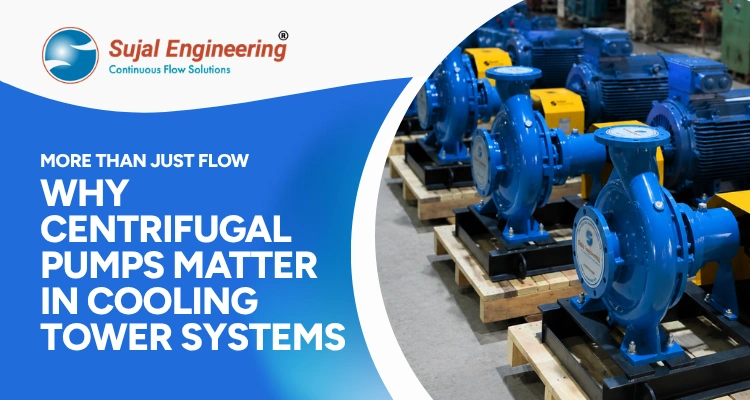
More Than Just Flow: Why Centrifugal Pumps Matter in Cooling Tower Systems
Introduction
Most plant engineers spend their time evaluating fill media, fan selection, and tower sizing when designing or upgrading a cooling tower system. The pump gets far less attention. Yet the centrifugal pump is the one component that keeps the entire heat rejection loop alive.
Cooling tower systems depend on continuous, reliable water circulation to transfer heat away from industrial processes, HVAC systems, and power generation equipment. When that circulation slows or stops, temperatures rise, equipment takes damage, and production is interrupted. A pump failure is never just a pump problem.
At Sujal Pumps, we supply centrifugal process pumps to plant engineers and procurement teams across chemical, pharmaceutical, power, and HVAC sectors. This guide covers why centrifugal pumps are central to cooling tower performance and what engineers need to know about selection, sizing, and maintenance.
Key Takeaways
- Centrifugal pumps drive heat rejection: They circulate water through the cooling loop continuously, making them the functional heart of every cooling tower system.
- Pump sizing directly affects efficiency: An oversized or undersized pump wastes energy, increases wear, and pushes the system away from its design operating point.
- Flow rate and total head must be matched to the system curve: Correct hydraulic calculations before pump selection prevent performance shortfalls and energy waste.
- NPSH margin is critical to preventing cavitation: Insufficient suction head causes impeller erosion, vibration, and early pump failure in cooling tower applications.
- Cooling tower water chemistry is aggressive: Dissolved minerals, treatment chemicals, and biological agents require careful pump material selection to prevent corrosion and fouling.
- Mechanical seal health determines service intervals: Seal wear from chemical exposure and particulate contamination is the most common maintenance issue in cooling tower pumps.
- VFD integration delivers measurable energy savings: Variable frequency drives reduce pump speed during low-load conditions, cutting power consumption and extending component life.
- Regular maintenance prevents costly unplanned downtime: Bearing checks, alignment verification, and impeller clearance assessments are the backbone of a reliable cooling tower pump program.
Is Your Cooling Tower Pump Sized for Maximum Efficiency?
Explore Sujal Pumps’ range of Centrifugal Process Pumps engineered for reliable, continuous industrial water circulation, superior hydraulic performance, and long service life in cooling tower applications.
View Centrifugal Process PumpsWhat Is the Role of a Centrifugal Pump in a Cooling Tower System?
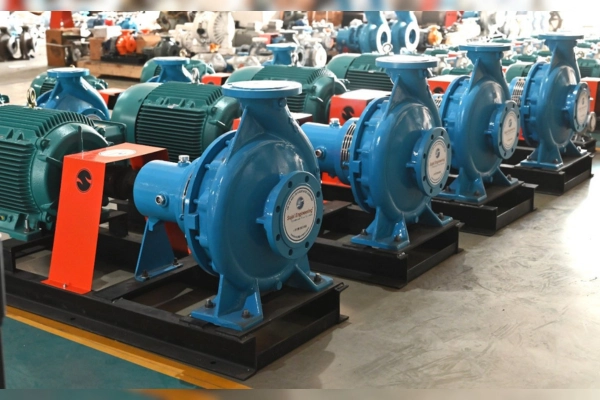
A centrifugal pump in a cooling tower system has one core job: to move water from the cold water basin at the base of the tower, through the connected heat exchangers or condensers, and back to the distribution system at the top. This closed loop is what enables continuous heat rejection.
The pump converts rotational energy from the motor into kinetic energy in the water. As the impeller spins, centrifugal force pushes water outward and builds the velocity and pressure needed to overcome pipe friction, elevation changes, and system resistance.
Without consistent flow from the pump, heat-laden water from the process cannot reach the tower. Temperatures rise, production is affected, and equipment life is shortened. Pump reliability is not a secondary concern in cooling tower design. It is a primary one.
How Does Water Circulation Keep Industrial Equipment Cool?
Heat rejection in a cooling tower works by absorbing heat from process equipment through a heat exchanger or condenser, carrying that heat-loaded water to the tower, and transferring it to the atmosphere through evaporation and airflow.
The pump keeps this entire loop moving at the correct velocity. The flow rate it delivers determines how quickly heat moves from the source to the tower and how well the system maintains target temperatures.
A 10% reduction in flow below the design rate means water spends longer inside the hot process equipment before reaching the tower. It arrives at a higher temperature, the tower cannot reject heat fast enough, and process temperatures climb. In industries where thermal control is critical, even small flow deficiencies have real consequences for quality, equipment, and energy costs.
Why Are Centrifugal Pumps the Best Choice for Cooling Tower Circulation?
Cooling tower systems need a pump that handles large volumes of low-to-medium viscosity water continuously, at relatively low to medium pressure, without pulsation. Centrifugal pumps meet all of these requirements better than any other pump type at this scale.
They deliver smooth, steady flow. This matters because cooling tower distribution nozzles and fill media require uniform water coverage across the entire tower cross section. Pulsating flow causes uneven distribution, dry zones in the fill, reduced evaporative efficiency, and hot spots in the connected process.
Centrifugal pumps are also straightforward to maintain, compatible with variable frequency drives, and available in materials that suit nearly every water chemistry. Understanding how a centrifugal pump works at a functional level is valuable for any engineer selecting or specifying cooling tower equipment.
Table 1: Centrifugal Pumps vs Other Pump Types for Cooling Tower Applications
| Factor | Centrifugal Pump | Rotary Gear Pump | Diaphragm Pump | Submersible Pump |
| Flow type | Smooth, continuous | Smooth, continuous | Pulsating | Continuous |
| Handles high flow volumes | Excellent | Limited | Limited | Moderate |
| Low-viscosity water suitability | Excellent | Less efficient | Moderate | Excellent |
| Energy efficiency at high flow | High | Low | Low | Moderate |
| VFD compatibility | Excellent | Moderate | Poor | Moderate |
| Maintenance complexity | Low | Moderate | Moderate | Moderate |
| Pressure range | Low to high | Medium to high | Low to medium | Low to medium |
| Common in cooling tower systems | Yes | Rarely | No | Occasionally |
For applications where flow volume, energy efficiency, and low maintenance cost are the priorities, centrifugal pumps are the clear choice.
Need Help Choosing the Right Centrifugal Pump?
Our experts at Sujal Pumps can help you select the ideal centrifugal pump based on your cooling tower’s flow rate, pressure, and operating conditions for reliable, energy-efficient performance.
Talk to Our Pump ExpertsWhat Are the Key Performance Factors That Affect Cooling Tower Pump Efficiency?
Pump efficiency in a cooling tower system is not simply about motor rating or power consumption. Several hydraulic and mechanical variables determine whether the pump delivers consistent, cost-effective performance across its service life.
How Are Flow Rate and Total Head Calculated for a Cooling Tower?
Flow rate is the volume of water the pump moves per unit of time, typically expressed in liters per minute (LPM) or cubic meters per hour (m3/h). Total head is the total resistance the pump must overcome, combining static height differences, pipe friction losses, and fitting resistance.
Both values must be calculated accurately before selecting a pump. Oversizing the pump wastes energy because the motor runs harder than the system needs. Under sizing means the system cannot achieve target temperatures because flow is too low to carry sufficient heat to the tower. Selecting a pump by matching it to the actual system curve at design conditions is the correct approach.
What Is NPSH and Why Does It Matter?
Net Positive Suction Head (NPSH) is the pressure available at the pump inlet above the vapor pressure of the liquid. If the available NPSH falls below what the pump requires, water begins to vaporize inside the pump casing, creating cavitation.
Cavitation causes vapor bubbles to collapse violently on the impeller surface, producing noise, vibration, pitting, and progressive impeller damage. It is one of the leading causes of premature pump failure in cooling tower applications. Ensuring adequate NPSH margin at the design stage is far less expensive than replacing an eroded impeller.
Why Does Material Selection Matter for Cooling Tower Pumps?
Cooling tower water is not clean, neutral water. It contains dissolved calcium and magnesium salts, microbiological growth, suspended particulates from the tower basin, and treatment chemicals including biocides, scale inhibitors, and corrosion inhibitors.
Cast iron casings perform well in mildly treated systems. Stainless steel or bronze impellers are preferred where chemical dosing is heavier. For particularly aggressive water chemistry, corrosion-resistant options such as polypropylene or other engineered polymer pumps deliver better durability. The material choice protects the pump investment over years of continuous service.
Table 2: Pump Selection Parameters for Cooling Tower Systems
| Parameter | Recommended Range or Consideration |
| Flow rate | Based on cooling duty; typically 3 to 5 LPM per kW of heat rejection |
| Total head | Usually 15 to 40 meters for most industrial cooling circuits |
| NPSH margin | Available NPSH should exceed pump requirement by at least 0.5 to 1.0 m |
| Casing material | Cast iron (standard), SS304/316 (treated water), PP (aggressive chemistry) |
| Seal type | Mechanical seal preferred for clean to moderately treated cooling water |
| Motor efficiency class | IE2 or IE3 for continuous-duty applications |
| VFD compatibility | Recommended for variable load or seasonal cooling systems |
| Operating speed | 1450 RPM or 2900 RPM; match to system curve for best efficiency point |
Cooling tower pump sizing is more precise than most engineers expect. Talk to our team at Sujal Pumps for a detailed flow and head analysis before committing to a specification.
What Common Problems Cause Centrifugal Pump Failures in Cooling Towers?
Even a correctly specified pump will fail early if certain operating conditions are not controlled. Understanding the most common failure modes allows maintenance teams to act before minor issues become costly breakdowns.
Cavitation: The Most Damaging and Preventable Problem
Cavitation forms when water pressure at the pump inlet drops below the liquid’s vapor pressure. Vapor bubbles form on the low-pressure side of the impeller and collapse violently when they reach the high-pressure zone. This erosion process produces a distinctive cracking or gravel-like sound from the pump casing.
The damage is cumulative and accelerates over time. A cavitating pump shows increased vibration, reduced flow, higher energy consumption, and visible pitting on the impeller blades. Addressing the root cause, whether an undersized suction pipe, a blocked strainer, or a pump installed too far above the basin water level, is the only real fix.
Seal Failures and How to Identify Them Early
Mechanical seals are the most vulnerable maintenance point in any cooling tower pump. The combination of mineral scale, chemical treatment agents, and fine suspended particles in the water attacks seal faces and wearing surfaces continuously.
Knowing how to inspect and install mechanical seals in centrifugal pumps is a practical skill for anyone responsible for cooling tower pump maintenance. External leakage near the seal housing, changes in vibration pattern, or heat generation at the shaft end are all early indicators that a seal is approaching failure.
Scale Buildup Inside the Pump Casing
Calcium and magnesium carbonates dissolved in cooling water precipitate at elevated temperatures and deposit on impeller blades, wearing rings, and casing walls. Over time, scale reduces clearances, increases surface roughness, and reduces hydraulic efficiency.
The solution requires both an active chemical water treatment program to control scaling tendency and scheduled internal inspections to catch buildup before it becomes significant.
How Should You Maintain a Centrifugal Pump in a Cooling Tower System?
A properly maintained centrifugal pump can run in a cooling tower system for years with minimal intervention. The key is consistent inspection routines and fast response to early warning signs before they escalate.
Bearing lubrication should follow the manufacturer’s specified interval, typically every three to six months for most industrial cooling applications. Over-lubrication is as damaging as under-lubrication. Follow specified quantities and use the correct grease grade for the operating temperature range.
Mechanical seal checks should happen quarterly. Look for external drips around the seal housing, changes in vibration signature, or elevated temperature near the shaft. These are early indicators that seal faces are wearing or contaminated.
Impeller clearance checks matter more than most maintenance teams realize. Worn wearing rings allow internal recirculation inside the casing, which reduces efficiency, generates heat, and accelerates wear in other components. Checking and adjusting clearances annually on high-duty pumps delivers measurable performance improvements.
Shaft alignment must be verified after every maintenance intervention. Even minor shaft misalignment between the pump and motor causes accelerated bearing wear, elevated vibration, and shortened seal life. Adopting energy-efficient pump operating practices, including VFD control and optimized pipeline layouts, reduces both maintenance frequency and long-term operating costs.
Preventive maintenance on your cooling tower pump consistently saves more than it costs. Visit Sujal Pumps to explore pump designs built for long service life and easy maintenance access.
Which Industries Rely Most on Cooling Tower Centrifugal Pump Systems?
Cooling towers are used across nearly every sector that generates significant process heat, and centrifugal pumps are the common denominator that keeps all of these systems running.
- Chemical and petrochemical plants use large cooling tower circuits for reactor cooling, condenser duty, and heat exchanger management. Corrosion-resistant pump materials are typically required because of aggressive water chemistry and process fluid contamination risks.
- Pharmaceutical manufacturing demands precise temperature control across production, fermentation, and purification stages. Cooling loops in these facilities operate continuously, and pump downtime has direct implications for batch integrity and regulatory compliance.
- Steel, cement, and glass plants generate substantial waste heat from furnaces, kilns, and rolling operations. Cooling tower pumps in these environments handle high temperatures, scale-prone water, and around-the-clock operation at heavy duty ratings.
- HVAC systems in commercial and industrial buildings use cooling towers in combination with chiller units to manage condenser water loops. The centrifugal pump circulates water between the chiller condenser and the cooling tower continuously during the cooling season.
- Power generation facilities depend on cooling towers to manage condenser heat rejection as part of the steam cycle. Pump reliability at these sites has a direct link to generation capacity and operational continuity.
- Food and beverage processing plants use cooling circuits for fermentation temperature control, pasteurization cooling, and storage refrigeration. Material compatibility with mild cleaning agents and food-grade treatment chemicals is a key selection criterion for pumps in these systems.
Conclusion
Centrifugal pumps do far more than move water from one point to another in a cooling tower system. They are the active component that makes continuous heat rejection possible across demanding industrial applications, day after day, under variable operating conditions.
Selecting the right pump, sizing it accurately for the cooling load, and maintaining it on a consistent schedule are the three practices that separate reliable cooling tower performance from recurring failures and unplanned downtime.
Sujal Pumps manufactures and supplies a full range of centrifugal process pumps engineered for industrial water circulation, HVAC system duty, and continuous-operation cooling tower applications. Whether you are specifying a new system, replacing an aging pump, or working through a performance problem, our team has the technical depth and application experience to help you make the right decision.
Sujal Pumps designs and manufactures centrifugal process pumps built for continuous industrial water circulation, cooling tower duty, and long service life in challenging environments. Visit www.sujalpumps.com and get in touch with our team to discuss the right pump solution for your cooling tower system.
Frequently Asked Questions
1. What type of centrifugal pump is best for cooling tower applications?
End suction centrifugal pumps and centrifugal monoblock pumps are the most widely used choices for cooling tower systems. They handle the continuous, moderate-pressure flows typical of cooling loops, are easy to maintain, and come in a range of materials to suit different water chemistries and operating temperatures.
2. How do I calculate the correct pump flow rate for a cooling tower?
Flow rate depends on the heat load the tower must reject, typically expressed in kilowatts or tons of refrigeration. A standard starting point is 3 to 5 liters per minute per kilowatt of heat rejection duty. The precise figure depends on the temperature differential between supply and return water and the water treatment program in use.
3. What causes cavitation in cooling tower centrifugal pumps?
Cavitation in cooling tower pumps is most commonly caused by insufficient Net Positive Suction Head (NPSH) at the pump inlet. This can result from excessively long or undersized suction pipework, high water temperature, blocked inlet strainers, or a pump installed too far above the basin water level.
4. How often should a cooling tower pump be serviced?
A standard maintenance program includes quarterly seal and bearing inspections, semi-annual lubrication, and annual impeller clearance and wear ring checks. Pumps running 24 hours a day in chemically treated water may need more frequent attention depending on actual water quality and duty conditions.
5. Can I use a variable frequency drive with a cooling tower centrifugal pump?
Yes. VFDs work very effectively with centrifugal pumps in cooling tower systems because cooling loads vary with ambient temperature, occupancy, and production schedules. Running the pump at reduced speed during lower-load periods cuts energy consumption substantially and extends bearing and seal life.
6. What pump materials are recommended for cooling tower water?
For standard treated cooling tower water, cast iron casings with bronze or stainless steel impellers are the common choice. Where chemical dosing is aggressive or water quality is poor, fully stainless steel construction or corrosion-resistant polypropylene designs offer better long-term durability.
7. How does pump oversizing affect cooling tower performance?
An oversized pump runs at a higher-than-designed flow rate, which increases energy consumption, creates excess pressure at the tower distribution nozzles, accelerates seal and bearing wear, and reduces hydraulic stability across the system. It also forces the pump to operate away from its best efficiency point, wasting energy on every operating hour.
8. What is the difference between a cooling tower pump and a condenser water pump?
In most industrial and HVAC applications, these terms describe the same pump. The cooling tower pump circulates water from the basin through the condenser or heat exchanger and back to the tower. In some complex systems, separate pumps may handle different sections of the circuit, but the centrifugal pump design principles and selection criteria remain the same throughout.