
How Filter Press Pumps Handle Rising Pressure During Filtration Cycles
Introduction: Why Pressure Management Is the Core Challenge in Filter Press Operations
A filter press pump does not just move slurry. It manages a system where resistance builds continuously, every single cycle. As filtration progresses, the filter cake thickens, and the flow path narrows. The pump must respond to this rising backpressure without cavitating, overloading, or losing filtration efficiency.
This is one of the most demanding operating conditions in industrial process equipment. Get it wrong, and you either filter the slurry or damage the press and the pump. Get it right, and you achieve consistent cake dryness, minimal downtime, and longer equipment life.
At Sujal Engineering, we have built and supplied filter press pumps for industries ranging from mining and chemicals to textiles and water treatment. This guide explains exactly how these pumps handle rising pressure, what happens inside the system at each stage of the filtration cycle, and how to choose the right pump for your application.
Key Takeaways
- Pressure rises naturally during filtration: As the filter cake builds up on filter cloths, flow resistance increases, causing system pressure to climb progressively throughout each cycle.
- Pump selection is critical: Centrifugal pumps and positive displacement pumps behave very differently under rising pressure, and each suits different stages or types of filtration operations.
- Flow rate decreases as pressure increases: This is a fundamental characteristic of centrifugal filter press pumps. Understanding this curve prevents both under-performance and equipment damage.
- High-pressure filtration requires purpose-built pumps: A standard centrifugal pump cannot safely operate at the peak pressures required in many industrial filter press applications without the right specifications.
- Automatic pressure control improves cycle efficiency: Modern filter press systems use pressure switches, variable frequency drives (VFDs), and sequencing controls to manage pump behavior across different filtration stages.
- Pump materials matter as much as pump type: Slurry chemistry, abrasiveness, and temperature determine whether you need cast iron, stainless steel, polypropylene, or PVDF-lined pump construction.
- Maintenance intervals are tied to pressure cycles: Every high-pressure cycle adds mechanical stress. Planned maintenance schedules tied to cycle counts extend pump service life significantly.
- Matching pump curves to filter press specifications prevents costly mismatches: Always verify that the pump head-flow curve intersects with the required filtration pressure at an acceptable flow rate.
What Actually Happens to Pressure During a Filtration Cycle?
To understand how a filter press pump handles rising pressure, you first need to understand what happens inside the filter press itself.
When a filtration cycle begins, the slurry enters the chambers between filter plates relatively freely. The filter cloths are clean, and resistance is low. At this stage, the pump delivers high flow at relatively low pressure. The slurry fills the chambers quickly.
As solid particles accumulate on the filter cloths, a filter cake starts to form. This cake acts as a secondary filter medium, which is actually beneficial for filtration quality. But it also means the slurry now has to push through a thicker and thicker barrier with every passing minute.
The result is a steady, predictable rise in system pressure throughout the cycle. By the time the chambers are fully loaded with cake, the pump is operating at maximum system pressure and minimum flow. This is sometimes called the “squeeze” phase of filtration. In many industrial applications, this terminal pressure can be anywhere from 6 bars to over 15 bars depending on the process.
The pump must perform reliably across this entire pressure range, from low-pressure, high-flow conditions at the start to high-pressure, low-flow conditions at the end. That dual demand is what makes filter press pump selection so technically important.
If you are not sure whether your current pump is matched to your filter press pressure curve, our team at Sujal Engineering can review your system specifications and recommend the right solution. Visit us at www.sujalpumps.com
How Does a Centrifugal Filter Press Pump Respond to Rising Pressure?
The centrifugal pump is the most widely used filter press feed pump in industrial operations. It works by converting rotational energy from a motor into kinetic energy in the fluid using an impeller. That kinetic energy then converts to pressure as the fluid decelerates through the volute casing.
The defining characteristic of any centrifugal pump is its head-flow curve. As system pressure (head) increases, the flow rate the pump delivers decreases. This is actually a useful property in filter press applications.
Here is what that means in practice:
At the start of the cycle, system pressure is low. The pump pushes a large volume of slurry into the press quickly, filling chambers fast. As cake builds and resistance rises, the pump’s output flow naturally decreases while it works harder against the increasing head. By the end of the cycle, flow is minimal, but the pump is still pushing slurry in at peak pressure.
This self-regulating behavior means centrifugal pumps do not need complex external controls to adapt to the changing conditions of a filtration cycle. The pump curve does the work automatically. However, it also means the pump motor must be sized correctly to handle peak pressure conditions without overloading, and the pump must be designed for the abrasive slurry it will handle.
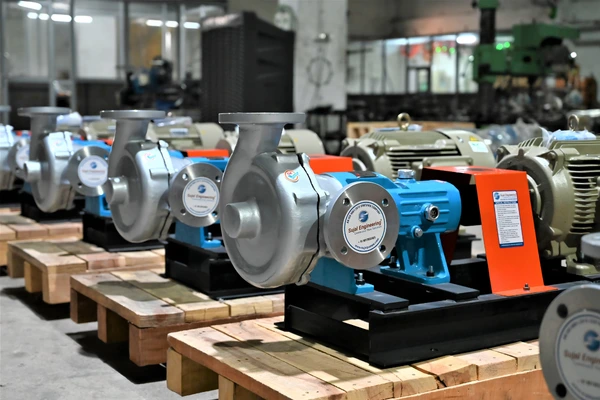
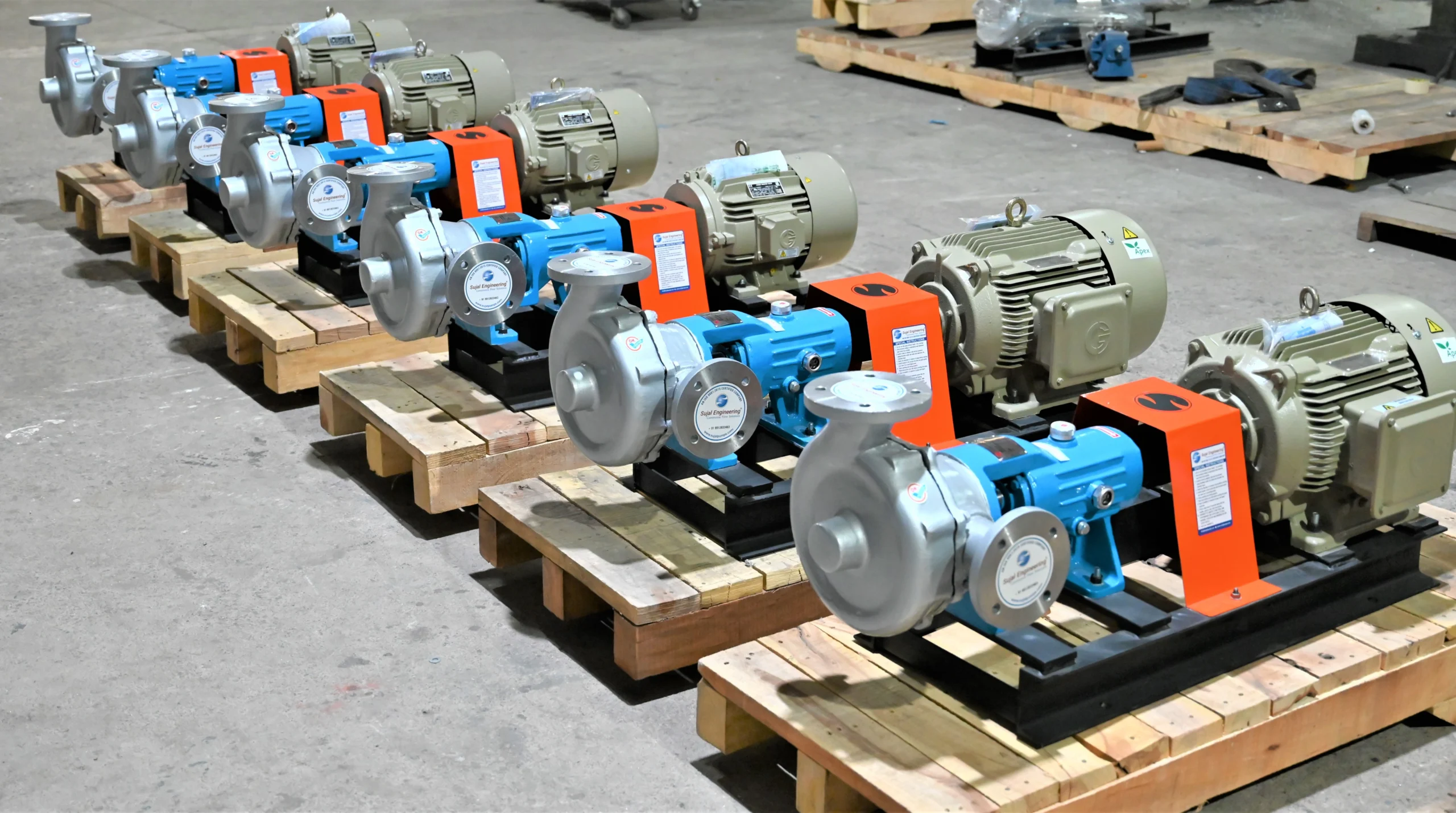
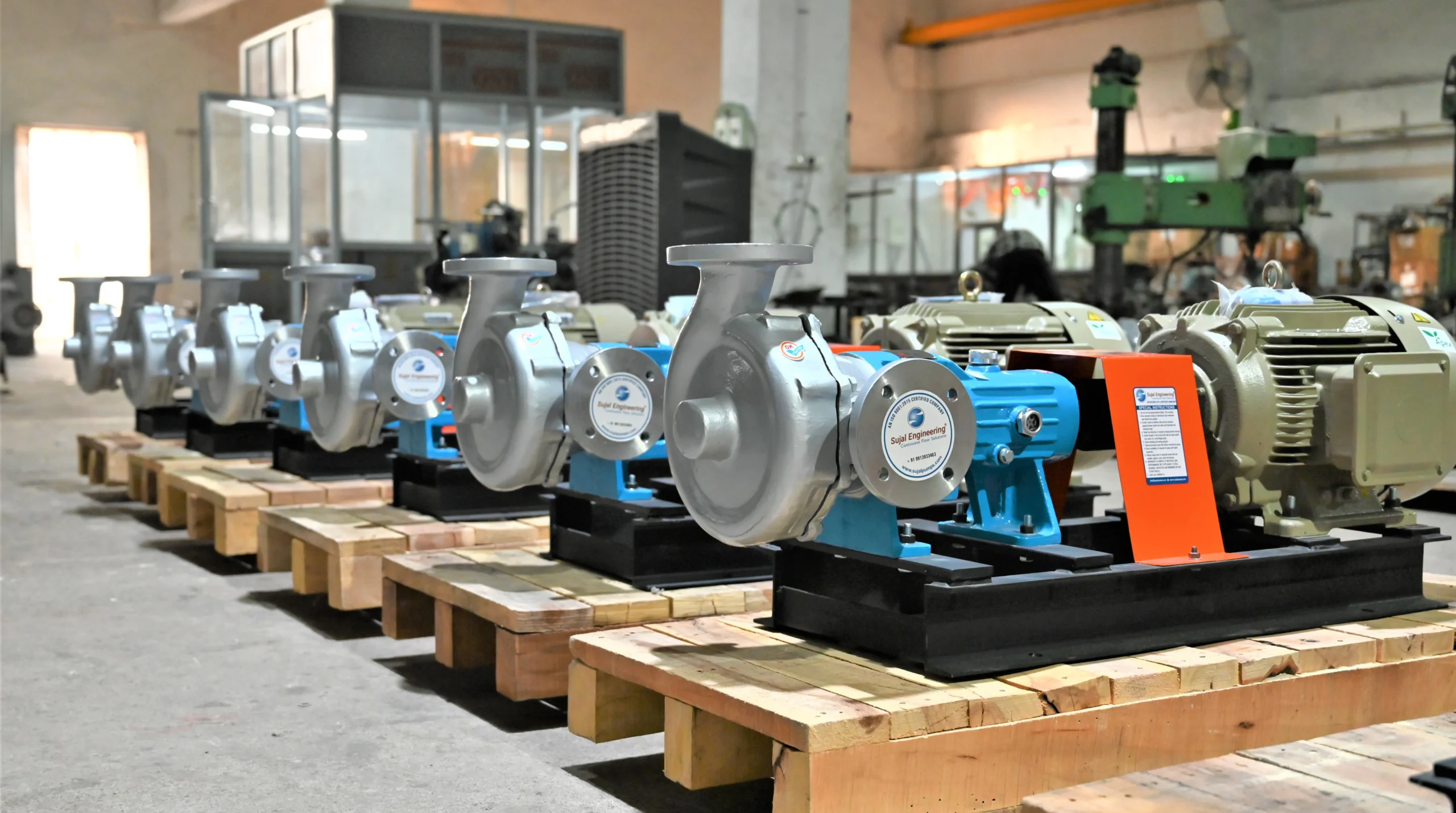
The Side Suction Filter Press Pump is Sujal Engineering’s purpose-designed solution for these demanding conditions. It combines the self-regulating characteristics of centrifugal pump operation with heavy-duty construction suited for slurry service in industries like mining, chemicals, ceramics, and wastewater treatment.
What Is the Filter Press Pump Working Principle in Simple Terms?
The filter press pump feeds slurry from a holding tank into the closed chambers of the filter press under pressure. As filtration proceeds and cake builds, the pump works against increasing back-pressure. When pressure reaches a set maximum (the filtration terminal pressure), the cycle is complete.
In simple terms:
- The pump starts the cycle at high flow, low pressure.
- It transitions through the mid-cycle at moderate flow, moderate pressure.
- It ends the cycle at low flow, maximum pressure.
- The pump then stops or is bypassed while the press opens, discharges cake and closes for the next cycle.
This cycle repeats dozens or hundreds of times per day in many industrial operations. The pump is not just moving liquid. It is the engine of the entire solid-liquid separation process.
Centrifugal vs. Positive Displacement: Which Pump Type Handles Rising Pressure Better?
This is the question engineers ask most often when specifying a filter press pump. The answer depends on the application, the slurry characteristics, and the filtration pressure requirements.
Comparison Table 1: Centrifugal vs. Positive Displacement Filter Press Pumps
Parameter | Centrifugal Pump | Positive Displacement Pump |
Flow behavior under rising pressure | Flow decreases as pressure rises | Flow remains relatively constant |
Maximum operating pressure | Typically, up to 10 to 12 bars | Can exceed 15 to 20 bars |
Slurry handling capability | Good for low to medium solids content | Better for high-solids, viscous slurries |
Self-regulation under load | Yes, naturally self-regulating | No, requires pressure relief valves |
Energy efficiency at low flow | Reduced efficiency at low flow | Maintains efficiency across flow range |
Capital cost | Lower | Higher |
Maintenance complexity | Lower | Higher |
Risk of overpressure | Low, naturally limits output | High, must use pressure relief devices |
Best suited for | General industrial filtration, mining, chemicals | High-pressure dewatering, pharmaceutical, fine chemicals |
For the majority of industrial filter press applications, centrifugal pumps are the preferred choice because of their self-regulating behavior and lower capital and maintenance costs. Positive displacement pumps are selected where very high final filtration pressures are required or where the slurry is too viscous or too high in solids content for a centrifugal pump to handle efficiently.
Not Sure Which Pump Type Is Right for Your Filter Press?
Our engineers at Sujal Engineering have matched pumps to filter presses across dozens of industries. Get expert guidance on selecting the most efficient and reliable solution for your application.
Reach Out to Our Team TodayHow Do Engineers Control Pressure During a Filtration Cycle?
Left completely uncontrolled, a filter press pump would either overload its motor, damage the filter press structure, or rupture filter cloths at the end of a cycle. Pressure management systems prevent this.
The three most common approaches are:
1. Fixed-Speed Pump with Pressure Switch Cutoff
The simplest approach. The pump runs at a fixed speed. When system pressure reaches the maximum setpoint (for example, 8 bar), a pressure switch signals the pump to stop or a bypass valve opens. This works well for simpler operations but is not energy-efficient because the pump runs at full power even when it is not needed.
2. Variable Frequency Drive (VFD) Control
A VFD adjusts the motor speed in response to system pressure feedback. At the start of the cycle, the pump runs at higher speed to deliver high flow. As pressure rises and flow demand drops, the VFD reduces pump speed, saving energy. At the end of the cycle, the pump operates at low speed under high pressure until the terminal pressure is reached. VFD-controlled filter press pumps are significantly more energy-efficient and produce less mechanical stress on the pump, extending service life.
3. Multi-Stage or Multi-Pump Sequencing
Some high-capacity operations use two or more pumps in sequence. A larger centrifugal pump handles the initial high-flow, low-pressure phase. As pressure rises and flow drops below the centrifugal pump’s efficient operating range, a smaller positive displacement pump takes over for the final high-pressure squeeze phase. This approach maximizes efficiency at both ends of the pressure cycle.
A well-designed filter press pumping system uses one or more of these strategies to match pump output to the actual demand at every stage of the cycle. This reduces energy consumption, extends equipment life, and improves cake quality and consistency.
What Pump Materials Are Required for Slurry and Chemical Filter Press Applications?
Material selection for a filter press pump is not optional engineering. It is a safety and reliability requirement. The wrong materials lead to accelerated wear, corrosion, contamination, and pump failure.
Sujal Engineering’s Polypropylene Pumps are widely used in chemical filter press applications where acids, alkalis, and aggressive solvents are present. The PVDF Pump range extends this further to handle even more aggressive chemical environments. For pharmaceutical and food processing filter press operations, stainless steel construction meets both chemical resistance and hygiene requirements.
Handling a corrosive or abrasive slurry in your filter press? Sujal Engineering offers pumps in polypropylene, PVDF, stainless steel, and cast iron to match your exact process requirements. Explore our full pump range
Which Industries Use High Pressure Filter Press Pumps?
Filter press pumping systems are found across virtually every sector of heavy industry. The pressure requirements, slurry characteristics, and filtration objectives vary significantly by sector.
Comparison Table 2: Filter Press Pump Requirements by Industry
Industry | Typical Slurry | Filtration Pressure | Recommended Pump Type |
Mining and Minerals | Ore tailings, concentrate slurry | 8 to 15 bar | Heavy-duty centrifugal or diaphragm |
Chemical Processing | Acid/alkali reaction slurry | 6 to 12 bar | Polypropylene or PVDF centrifugal |
Wastewater Treatment | Sewage sludge, ETP effluent | 5 to 10 bar | Centrifugal, self-priming mud pump |
Pharmaceutical | Active ingredient cake, API slurry | 6 to 10 bar | SS centrifugal, hygienic design |
Food Processing | Sugar, starch, edible oil slurry | 4 to 8 bar | Stainless steel centrifugal |
Textile and Dye | Dye sludge, color process effluent | 5 to 10 bar | Polypropylene centrifugal |
Paper and Pulp | Fiber slurry, pulp reject | 5 to 8 bar | Heavy-duty centrifugal |
Ceramics | Clay slurry, kaolin | 8 to 12 bar | Side suction filter press pump |
Oil and Gas | Drilling mud, produced water | 10 to 20 bar | High-pressure positive displacement |
Each industry brings unique challenges around abrasion, corrosion, temperature, and required cake dryness. The pump that works perfectly in a textile ETP plant will likely underperform or fail in a mining concentrate dewatering application. This is why proper application engineering at the selection stage saves far more money than it costs.
If you want to understand more about high-pressure slurry handling in detail, the Sujal Engineering guide on high pressure slurry transfer pumps covers the subject thoroughly across multiple industrial sectors.
What Are the Common Pressure-Related Problems in Filter Press Pump Systems?
Even well-selected pumps can run into pressure management problems if the system around them is not properly designed or maintained. Here are the most common issues and what causes them.
- Pressure drop across long pipelines: Long suction or discharge lines with undersized diameters create friction losses that the pump must overcome. This effectively raises the system pressure the pump sees and can push it outside its efficient operating range.
- Blocked or blinded filter cloths: When filter cloths are not cleaned between cycles, residual cake can block them partially. The pump then sees abnormally high pressure from the very start of the cycle, which can overload it or lead to premature shutdown.
- Cavitation at the pump inlet: At high operating pressures, if the suction conditions are poor (long suction line, high slurry density, high elevation), the pump can cavitate. Cavitation at high system pressure is particularly destructive because the implosion forces are more severe.
- Motor overload at peak cycle pressure: If the pump motor is not sized with adequate margin for peak pressure conditions, it will trip on overload protection at the end of every cycle. This interrupts filtration and causes premature motor and pump wear.
- Wear on seals and mechanical components: Repeated pressure cycling from near-zero to peak pressure stresses mechanical seals, gland packing, and bearing assemblies. A well-designed filter press pump includes robust sealing and bearing arrangements that can handle thousands of pressure cycles without failure.
Regular maintenance and proper initial design address all of these issues. The Sujal Engineering blog on feed pump selection for filter presses covers many of these design considerations in practical detail.
Experiencing Pressure Trips, Cavitation, or Premature Pump Wear in Your Filter Press System?
Our team can diagnose the root cause of performance issues and recommend the right pump solution to improve reliability, efficiency, and equipment life.
Contact Sujal EngineeringHow to Select the Right Filter Press Pump for Your Application
Selecting a filter press pump is not as simple as matching horsepower to filter press size. There are six core parameters every engineer must specify correctly.
Step 1: Define the slurry characteristics: Know the solid content (percentage by weight), particle size, abrasiveness, pH, temperature, and viscosity of the slurry. These parameters determine pump materials, impeller type, and seal selection.
Step 2: Determine the required flow rate: Calculate the volume of slurry to be filtered per cycle and the acceptable cycle time. This gives you the average flow rate the pump must deliver during the filling phase.
Step 3: Identify the terminal filtration pressure: This is the maximum pressure at which the filter press operates at the end of the cycle. The pump must be capable of delivering at least this pressure at the minimum required flow.
Step 4: Plot the system curve against the pump curve: A filter press system has a rising resistance curve. The pump’s head-flow curve must intersect this system curve at appropriate points across the full cycle, not just at one operating point.
Step 5: Select the motor with adequate margin: The motor must be sized for peak pressure operation at the end of the cycle, not average operating conditions. A minimum of 10 to 15 percent power margin above calculated peak requirements is standard practice.
Step 6: Choose materials for chemical and abrasion resistance: Match wetted-part materials to slurry chemistry. Cast iron for neutral, non-corrosive slurries. Polypropylene or PVDF for acids and alkalis. Stainless steel for pharmaceutical or food-grade applications.
Following these six steps systematically prevents the most common and costly errors in filter press pump specification.
Energy Efficiency Considerations for Filter Press Pumping Systems
Energy consumption in filter press operations is dominated by the pump. In facilities running multiple filter presses continuously, pumping can represent 30 to 50 percent of total process energy costs. Optimizing pump selection and control strategy offers real financial returns.
VFD-controlled centrifugal pumps can reduce energy consumption in filter press applications by 20 to 40 percent compared to fixed-speed systems with bypass valve control. The savings are greatest in applications with long cycle times where the pump spends significant time at reduced flow against high pressure.
Proper impeller sizing also matters. An oversized impeller running with a partially closed discharge valve wastes energy continuously. Matching the impeller diameter to the actual operating range of the system curve eliminates this waste.
Energy-efficient filter press pump systems also tend to have lower maintenance costs because reduced mechanical stress on the pump, motor, and seals translates directly into longer component life between planned service intervals.
Conclusion: The Right Filter Press Pump Manages Pressure, Not Just Flow
A filter press pump that cannot handle rising pressure gracefully is a liability, not an asset. The pump is the heart of the filtration cycle. Its ability to deliver the right flow at the right pressure at every stage of the cycle determines filtration quality, cycle time, energy consumption, and equipment longevity.
The key decisions are: centrifugal versus positive displacement based on your pressure and slurry requirements, material selection based on chemical compatibility, motor sizing based on peak cycle conditions, and control strategy based on energy efficiency targets.
At Sujal Engineering, we have been engineering industrial pumps for demanding applications across India and global markets for decades. Our Side Suction Filter Press Pumps are purpose-designed for the pressure cycling demands of industrial filter press operations, and our range of centrifugal, polypropylene, PVDF, and stainless-steel pumps covers every slurry chemistry and pressure requirement across sectors from mining to pharmaceuticals.
If you are commissioning a new filter press, troubleshooting an existing pumping system, or upgrading for better energy efficiency, our team is ready to help. Connect with our experts at Sujal Engineering and let us find the right filtration pump solution for your plant.
Frequently Asked Questions (FAQ)
1. What is a filter press pump and what does it do?
A filter press pump feeds slurry from a holding tank into the chambers of a filter press under controlled pressure. It drives the solid-liquid separation process by forcing liquid through filter cloths while solids accumulate as a cake. The pump must manage a continuously rising system pressure as the cake builds during each filtration cycle.
2. Why does pressure increase during filtration cycles?
As filtration progresses, solid particles accumulate on the filter cloths and form a cake. This cake increases the resistance to flow, which causes system pressure to rise. The thicker the cake becomes, the higher the pressure needed to push filtrate through it. This is a natural and expected part of the filtration process.
3. What type of pump is best for a filter press?
Centrifugal pumps are most commonly used for filter press applications because their head-flow curve naturally adapts to rising pressure by reducing flow, which matches the filtration cycle demand profile. Positive displacement pumps are used where very high final pressures or highly viscous slurries are involved.
4. What is the maximum pressure a filter press pump can handle?
Standard industrial centrifugal filter press pumps typically handle pressures up to 10 to 12 bar. Heavy-duty positive displacement pumps can operate at 15 to 20 bar or higher. The right maximum pressure rating depends on the specific filter press design and process requirements.
5. How does a VFD improve filter press pump performance?
A Variable Frequency Drive adjusts pump motor speed in response to system pressure feedback. At the start of the cycle when pressure is low and high flow is needed, the pump runs faster. As pressure rises and flow drops, the VFD reduces speed, saving energy and reducing mechanical stress. VFD control can reduce filter press pumping energy consumption by 20 to 40 percent.
6. What causes cavitation in a filter press pump?
Cavitation occurs when the pressure at the pump inlet drops below the vapor pressure of the liquid, causing vapor bubbles to form and collapse violently. In filter press applications, it is typically caused by long or undersized suction pipework, high slurry density, high operating temperature, or insufficient net positive suction head (NPSH). Cavitation causes impeller erosion and significantly reduces pump life.
7. How do I know if my filter press pump is undersized?
Signs of an undersized filter press pump include unusually long filtration cycle times, failure to reach terminal filtration pressure, motor tripping on overload, and poor cake dryness. Comparing the pump’s performance curve against the actual system curve at your operating conditions will confirm whether the pump is correctly matched to the application.
8. How often should a filter press pump be serviced?
Service intervals depend on slurry abrasiveness, operating pressure, and daily cycle count. A typical maintenance schedule for a filter press pump handling moderately abrasive slurry would include seal inspection and replacement every 2,000 to 3,000 operating hours, impeller wear checks every 5,000 hours, and bearing replacement based on vibration monitoring data. High-abrasion slurries require more frequent inspection.