

The Critical Role of Double Helical Gear Pumps in High Temperature Bitumen and Asphalt Transfer
Introduction
If your plant handles hot bitumen or molten asphalt, you already know that selecting the wrong pump is not just a performance issue – it is a safety and operational liability. At temperatures exceeding 200°C and with viscosities that can swing from 50,000 cP to over 500,000 cP depending on grade and temperature, bitumen punishes underpowered, ill-suited pumps without mercy.
Double helical gear pumps are the established solution for these conditions. Their design handles pulsation-free, continuous flow of extremely viscous, high-temperature fluids without the wear patterns that destroy standard gear pump configurations in months. From road construction batch plants and asphalt refineries to bitumen emulsion units and polymer-modified asphalt (PMA) systems, these pumps are present in every critical transfer point of the process.
This post explains exactly why double helical gear pumps dominate high-temperature bitumen handling, what makes them different from other pump types, how to size and select one correctly, and what maintenance practices actually extend pump life in demanding asphalt environments. Sujal Pumps has supplied heavy-duty industrial gear pumps across bitumen, petrochemical, and thermal fluid applications – and everything in this guide is grounded in real-world application experience.
Key Takeaways
- Double helical gear pumps are built for viscous, high-temperature duties: Their dual-helix gear geometry eliminates axial thrust and enables smooth, pulse-free flow — making them uniquely suited for hot bitumen and asphalt transfer.
- Bitumen viscosity is highly temperature-dependent: A pump correctly specified for 180°C operation may cavitate or overload if the fluid temperature drops and viscosity spikes unexpectedly.
- Standard gear pumps fail faster in bitumen service: The axial thrust in spur gear designs accelerates bearing wear when handling heavy, viscous media at elevated temperatures.
- Jacket heating is non-negotiable: Every double helical gear pump used in bitumen service must include a jacketed body, cover, and port connections to maintain fluid temperature and prevent solidification.
- Continuous flow is a process advantage: Unlike piston or diaphragm pumps, double helical gear pumps deliver consistent, metered, pulsation-free flow that supports downstream blending and spraying accuracy.
- Material selection determines service life: Pump internals should be specified in cast iron or steel for bitumen grades below 200°C, with hardened steel or ductile iron for polymer-modified asphalt at elevated temperatures.
- Correct speed selection protects gears: Running a bitumen gear pump at too high a speed accelerates wear; these pumps are designed for low-to-medium RPM continuous duty at high torque.
- Maintenance intervals in bitumen service are shorter: The combination of heat, abrasive filler particles in some asphalt grades, and high torque loading requires tighter inspection cycles than standard process pump applications.
What Makes Bitumen and Asphalt So Difficult to Pump?
Bitumen is not simply a thick liquid. It is a complex, temperature-sensitive hydrocarbon mixture with a viscosity profile that changes dramatically across a relatively narrow temperature range. At ambient temperatures, bitumen is solid or near solid. At 160°C to 180°C, typical handling temperatures, it becomes a heavy, slow-moving fluid. At 220°C or higher, viscosity drops further, but thermal degradation and oxidation risks increase.
Asphalt, which is essentially bitumen combined with mineral aggregates or fillers in various formulations, introduces additional challenges. Polymer-modified asphalt (PMA) and bitumen emulsions require precise temperature control during transfer to maintain product quality and prevent premature crosslinking or phase separation.
The core challenges any pump must address when handling these fluids include:
- Very high viscosity (5,000 to 500,000+ cP depending on grade and temperature)
- High operating temperatures (140°C to 230°C depending on application)
- Tendency to solidify and seize pump internals if temperature drops even briefly
- Presence of abrasive mineral particles in modified asphalt grades
- Need for precise metered flow with no pulsation in blending or spray applications
- Requirement for high differential pressure to push the fluid through the transfer system
Centrifugal pumps cannot handle these duties. Their performance collapses as viscosity rises, and they require continuous priming conditions that hot bitumen simply does not provide consistently. Piston pumps generate pulsation and require complex valve arrangements prone to blockage. Gear pumps — specifically double helical gear pumps — were engineered to address exactly this combination of conditions.
If you are specifying a pump for a bitumen handling or asphalt transfer system and want to confirm you have the right configuration, speak to our team at Sujal Pumps before procurement getting this right at the selection stage saves significant cost and downtime later.
How Does a Double Helical Gear Pump Work?
A double helical gear pump belongs to the positive displacement pump family. It transfers fluid by trapping fixed volumes between rotating gear teeth and the pump casing, then displacing those volumes from suction to discharge with each rotation.
The defining feature is the gear geometry. Standard external gear pumps use spur (straight-cut) teeth, which create axial (sideways) thrust forces on the gear shafts and bearings as the teeth mesh and unmesh. Under high-viscosity, high-temperature loads, this axial thrust accelerates bearing wear and reduces pump service life significantly.
Double helical gears also called herringbone gears solve this problem by using two sets of helical teeth cut in opposite directions on the same gear body. The two helical sets produce equal and opposite axial thrust forces that cancel each other out. The result is a gear with the smooth, quiet engagement of a helical gear design and zero net axial load on the shaft bearings.
This makes a fundamental difference in bitumen service because:
- Zero axial thrust means bearings last far longer under the high torque loads of viscous fluid transfer
- Helical tooth engagement is gradual rather than sudden, which produces smooth, pulsation-free flow
- The continuous contact ratio of helical teeth provides better sealing between the gear flanks and casing, improving volumetric efficiency at low speeds
- The robust gear geometry handles the high starting torque required when pumping cold or partially cooled bitumen
Understanding how gear pump geometry affects performance in high-viscosity applications is an essential context for anyone selecting pumps for bitumen or asphalt systems.
Double Helical vs. Single Helical vs. Spur Gear Pumps – Key Differences
| Feature | Spur Gear Pump | Single Helical Gear Pump | Double Helical Gear Pump |
| Axial Thrust | High | Present, one direction | Zero (self-canceling) |
| Noise Level | High | Medium | Low |
| Flow Pulsation | Moderate | Low | Very Low |
| Bearing Load | High | Medium | Low |
| Suitability for High Viscosity | Limited | Moderate | Excellent |
| Starting Torque Handling | Low | Medium | High |
| Recommended for Bitumen Service | No | Marginal | Yes |
| Cost | Lower | Medium | Higher, justified by life |
The difference in bearing load alone explains why double helical designs are the standard specification in bitumen pumping systems globally. In high-torque, continuous-duty applications, the longer bearing life more than paying back the additional initial cost within the first operating year.
Where Are Double Helical Gear Pumps Used in Bitumen and Asphalt Operations?
These pumps appear at multiple critical points across the bitumen and asphalt value chain. Understanding each application helps with correct sizing and specification for each duty point.
1. Storage Tank Unloading and Loading
Hot bitumen arrives at refineries, storage terminals, and batch plants in heated tankers or rail cars. The pump must be capable of handling highly viscous fluid at suction conditions with very low net positive suction head available (NPSHa). Double helical gear pumps handle these conditions without cavitation because they do not rely on velocity to move fluid — they physically displace it.
The pump in this service must have a jacketed body and inlet port to prevent the fluid from cooling and thickening on the low-pressure suction side. Many plants also use a separate tank circulation loop to maintain bitumen temperature and homogeneity during storage.
2. Transfer from Storage to Process
Moving bitumen from bulk storage to mixing drums, emulsion plants, or spray systems requires sustained, metered flow at controlled pressure. This is exactly the duty double helical gear pumps are designed for. The positive displacement mechanism means flow rate is directly proportional to pump speed, which makes variable speed drives (VFDs) an effective tool for flow control.
3. Bitumen Emulsion Manufacturing
Emulsion plants require precise, continuous delivery of bitumen into the colloid mill at a stable, metered rate. Any flow pulsation disrupts the bitumen-to-water ratio in the mill and produces inconsistent emulsion quality. The pulsation-free flow of double helical gear pumps is a direct operational requirement here, not just a preference.
4. Polymer-Modified Asphalt (PMA) Systems
PMA requires blending of base bitumen with polymer modifiers (SBS, EVA, or similar) at high temperatures. The pump transfers hot bitumen into the blending unit and must handle a fluid that is both highly viscous and increasingly elastic as polymer content rises. Double helical gear pumps with appropriate clearances and materials are specified for this service.
5. Hot Mix Asphalt (HMA) Plants
In drum mix and batch mix asphalt plants, bitumen is injected into the aggregate at the correct rate and temperature to achieve the required binder content. The pump must deliver consistent metered flow at high temperature, often against variable back-pressure as aggregate feed rates change. This is a continuous duty cycle that demands robust bearing design and reliable thermal management.
If you are designing a new asphalt plant or upgrading your bitumen transfer system, our team at Sujal Pumps can help you identify the right pump configuration, including jacketing arrangement, shaft sealing, and drive specification for your specific process conditions.
What Are the Critical Design Features of Bitumen-Grade Double Helical Gear Pumps?
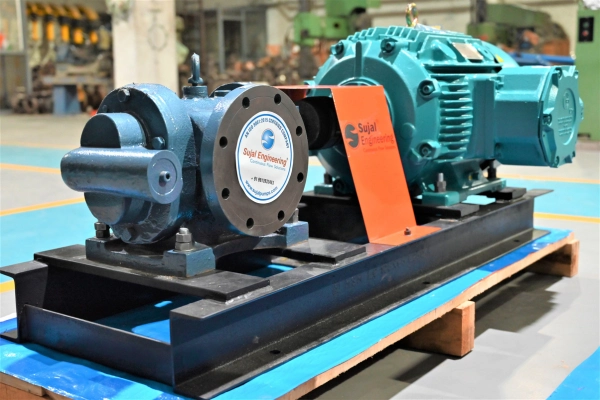
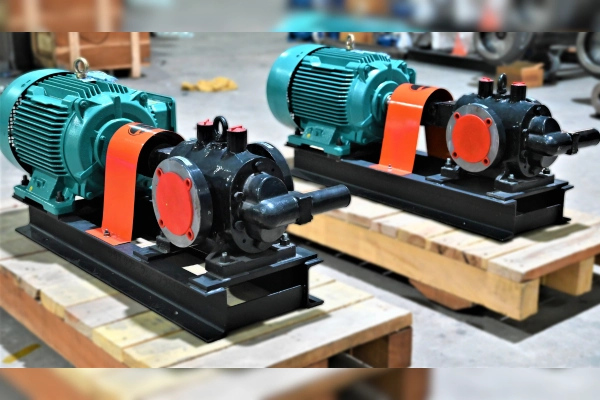
Not every double helical gear pump is fit for bitumen service. Several specific design features must be present to ensure the pump survives the combination of high temperature, high viscosity, and continuous duty.
1. Full Jacketing of Pump Body and End Covers
The pump casing, both end covers, and all port connections must be jacketed for hot oil or steam heating medium circulation. This maintains fluid temperature across the entire pump wetted surface and prevents bitumen from cooling, thickening, and eventually solidifying in low-flow zones.
Pumps without full jacketing may work briefly but will accumulate cold bitumen in the end cover recesses and around the shaft seal areas. This leads to rapid seal failure and, in severe cases, complete seizure of the gear set.
2. Mechanical Seal or Packing with Thermal Management
Shaft seals in bitumen service operate in one of the most demanding sealing environments in industrial process work. The combination of high temperature, high viscosity, and the tendency of bitumen to carbonize on contact with air makes seal selection critical.
Most high-temperature bitumen gear pumps use either a mechanical seal with external quench and flush arrangement, or a packed gland seal with adjustable follower. The sealing medium must be compatible with bitumen, and the seal chamber should be included in the jacketing circuit to maintain temperature and prevent solidification around the seal faces.
3. Hardened Gear and Shaft Materials
Bitumen often carries fine mineral particles, particularly in recycled asphalt or cut-back bitumen grades. These particles act as abrasives against the gear flanks, shaft journals, and casing bore. Gear and shaft materials should be specified in hardened alloy steel or ductile iron, and internal clearances should be set to the tighter end of the manufacturer’s tolerance range to minimize slippage and maintain volumetric efficiency.
4. Relief Valve Protection
All positive displacement pumps, including double helical gear pumps, must be protected by a pressure relief valve on the discharge side. Bitumen systems are prone to blockage in downstream pipework if temperature is lost. Without a relief valve, the pump will build pressure against a closed system until mechanical failure occurs in the weakest component.
The relief valve should be set at 10% to 15% above the maximum normal operating pressure, and it should bypass to the suction side (internal bypass) rather than a separate line to maintain system temperature.
5. Low-Speed, High-Torque Drive Arrangement
Double helical gear pumps in bitumen service are typically driven through a gearbox at 150 to 400 RPM. Higher speeds increase internal velocities and wear rates without proportional flow benefit the viscosity of the fluid limits the effective speed range for efficient operation.
Variable frequency drives (VFDs) are increasingly standard on bitumen transfer pumps because they allow the speed to be adjusted as fluid viscosity changes with temperature. A well-configured VFD also provides soft-start capability, which reduces mechanical shock on startup when the pump is filled with cooled, highly viscous bitumen.
How Do Double Helical Gear Pumps Compare to Other Options for Bitumen Transfer?
Plant engineers sometimes consider alternatives when specifying bitumen pumps, particularly when dealing with cost pressures or unfamiliarity with gear pump technology. The comparison is worth examining in detail.
Comparison: Pump Types for High Temperature Bitumen Transfer
| Pump Type | Suitable for Bitumen? | Temperature Limit | Viscosity Handling | Pulsation | Typical Life in Bitumen Service | Notes |
| Double Helical Gear Pump | Yes | Up to 300°C+ | Excellent (>500,000 cP) | None | 3 to 7 years+ | Industry standard for bitumen |
| Standard Spur Gear Pump | Marginal | Up to 200°C | Good | Low | 1 to 3 years | Axial thrust limits bearing life |
| Progressive Cavity Pump | Partial | Up to 120°C | Excellent | None | 1 to 2 years in hot bitumen | Stator elastomer limits temperature |
| Piston Pump | Not recommended | Up to 200°C | Good | High | Moderate | Valve maintenance intensive |
| Centrifugal Pump | No | N/A | Poor above 200 cP | None | Very short | Performance collapse at high viscosity |
| Lobe Pump | Partial | Up to 200°C | Moderate | Low | 2 to 3 years | Timing gears required |
The data above reflects industry practice in bitumen and asphalt plant operations globally. Progressive cavity pumps are popular for lower-temperature bitumen emulsion services but are not suitable for hot bitumen transfer above 120°C due to elastomer limitations in the stator.
Double helical gear pumps hold the advantage because they are the only type that simultaneously addresses high temperature, very high viscosity, pulsation-free flow, continuous duty, and long service life without requiring frequent elastomer or valve replacement.
Sujal Pumps manufactures the Double Helical Flange Type Gear Pump specifically for duties like bitumen and asphalt transfer if you want to discuss sizing, material selection, or jacket configuration for your application, get in touch with our team today.
How Do You Specify a Double Helical Gear Pump for a Bitumen Application?
Correct specification is where most errors occur in bitumen pump procurement. Engineers sometimes rely on water-based sizing data and fail to account for the dramatic effect of viscosity on gear pump performance and power consumption.
Step 1: Define the Fluid Parameters
You need the following data before sizing begins:
- Bitumen grade (penetration grade, viscosity grade, or polymer-modified)
- Operating temperature range (minimum, normal, maximum)
- Viscosity at minimum and maximum operating temperature (in cP or mPas)
- Density at operating temperature
- Presence of mineral fillers or polymer content
- Flash point (to confirm thermal management requirements)
Step 2: Calculate Required Flow Rate and Differential Pressure
Flow rate is typically defined by process requirements – how much bitumen needs to move per hour to meet downstream demand. The differential pressure must account for:
- Static head (elevation difference between suction and discharge)
- Line losses in hot bitumen pipework (which are significant due to viscosity)
- Equipment resistance (colloid mill, spray nozzle pressure, mixing drum)
Step 3: Select Pump Speed and Size
Gear pump capacity increases proportionally with speed, but there is an upper limit beyond which performance suffers in high-viscosity service. A common starting rule is to size the pump for approximately 70% to 80% of its maximum rated speed at normal operating viscosity. This provides headroom for higher viscosity conditions and reduces wear on the gear set and bearings.
For bitumen at 180°C, typical pump speeds range from 200 to 350 RPM for flow rates of 5 to 50 m³/hr, depending on pump displacement per revolution.
Step 4: Specify Drive, Seal, and Jacketing
- Drive: Gear reducer with VFD for variable bitumen grades and temperatures
- Shaft seal: Mechanical seal with quench or packed gland with heating jacket
- Jacketing: Full-body jacket for thermal oil or steam, rated for operating pressure of heating medium
- Relief valve: Set at 10% to 15% above maximum operating pressure, bypass to suction
Selecting the right pump based on fluid properties and application conditions is a process that applies across many viscous fluid applications — the principles for bitumen follow the same framework.
Accurate pump sizing for bitumen applications requires knowing your exact viscosity and temperature data. Share your application details with our team and we will confirm the right pump size, material specification, and drive configuration.
What Are the Common Failure Modes in Bitumen Gear Pumps — and How Do You Prevent Them?
Understanding failure modes is as important as selecting the right pump. Bitumen service has specific failure patterns that are predictable and, with the right practices, preventable.
Bearing Failure from Inadequate Warming
Starting a double helical gear pump filled with cold or partially cooled bitumen is one of the most common causes of bearing failure in bitumen service. Cold bitumen at high viscosity creates starting torques that can exceed the rated design load by a factor of three to five times. The bearings absorb this shock and are progressively damaged with each cold start.
Prevention: Always circulate heating medium through the jacket before startup. Allow the pump body temperature to reach within 20°C of the target operating temperature before initiating pump rotation. Use a VFD for controlled soft-start even after the pump body is at temperature.
Shaft Seal Failure from Carbonization
Bitumen oxidizes and carbonizes on contact with air, and seal leakage accelerates this process. Carbonized bitumen accumulates on the seal faces and eventually causes face damage, spring jamming, or bellows failure in mechanical seals.
Prevention: Ensure the seal chamber is fully included in the jacketing circuit. Use a compatible quench medium on the atmospheric side of the mechanical seal to prevent air contact with leaked bitumen. Inspect seal condition regularly and replace at the first signs of leakage.
Internal Wear from Abrasive Fillers
Modified asphalt and some bitumen grades contain fine mineral dust or polymer particles that abrade internal surfaces. Clearances between gear tips and the casing bore gradually increase, reducing volumetric efficiency and flow at a given speed.
Prevention: Use hardened gear and shaft materials during specification. Monitor pump performance (flow rate and pressure at constant speed) to detect efficiency loss over time. Replace gear set when volumetric efficiency drops below the manufacturer’s minimum tolerance.
Blockage from Fluid Solidification
A loss of heating medium supply even briefly can allow bitumen in the pump body to cool and partially solidify. In severe cases, the gear set becomes locked and cannot restart even after temperature is restored.
Prevention: Install a heating medium failure alarm with automatic pump shutdown to prevent the gear set from being driven against solidified bitumen. Install drain valves at the pump body low points to allow the pump to be flushed with a solvent or hot oil if solidification does occur.
Regular maintenance aligned with correct shutdown and startup procedures is the single most effective way to extend pump service life in bitumen service. Following structured maintenance practices across all industrial pump types reduces both failure rate and unplanned downtime.
What Are the Safety Considerations in Hot Bitumen Pumping Systems?
Hot bitumen is a significant burn hazard. At operating temperatures of 160°C to 230°C, a leak under pressure causes immediate and severe thermal injury to nearby personnel. Beyond direct burn risk, bitumen vapors at elevated temperatures can be harmful with prolonged exposure.
Key safety requirements for double helical gear pump installations in bitumen service:
- All flanged connections must use spiral-wound or ring-type gaskets rated for the operating temperature and the specific corrosivity of the bitumen grade
- Insulation cladding on pump body and pipework reduces surface temperature and minimizes heat loss, but must be removable for inspection access
- Personal protective equipment (PPE) requirements for operators near hot bitumen systems should include heat-resistant gloves, face shield, and full arm coverage
- Emergency stop and remote isolation should be provided for all bitumen pump stations
- Relief valve discharge should be directed to a contained collection point, not open-air discharge, to prevent fire risk and environmental contamination
Compliance with local process safety standards and hazardous area classification requirements for bitumen handling facilities is not optional — it is foundational to safe operation.
Conclusion: Why Double Helical Gear Pumps Are the Right Choice for Bitumen and Asphalt Transfer
When the fluid is hot, heavy, and completely unforgiving of equipment failure, every component in the transfer system must be specified with precision. Double helical gear pumps deliver the combination of zero axial thrust, pulsation-free continuous flow, robust thermal management, and high-torque low-speed operation that bitumen and asphalt applications genuinely require.
No other pump type matches this combination of capabilities across the temperature and viscosity ranges typical of hot bitumen service. That is not a marketing claim it is reflected in the engineering practices of every major road construction plant, bitumen terminal, and asphalt emulsion manufacturer globally.
Sujal Pumps manufactures the Double Helical Flange Type Gear Pump designed for exactly these heavy-duty, high-temperature viscous fluid transfer applications. Whether you are setting up a new asphalt plant, replacing a failing pump in an existing system, or conducting a technical review of your current pump selection, our team can help you arrive at the right solution with confidence.
Get in touch with our team at Sujal Pumps to discuss your bitumen or asphalt pumping requirements. We are here to help you specify the right pump, confirm the correct sizing and materials, and support your installation from procurement through commissioning. Contact us today at sujalpumps.com.
Frequently Asked Questions
1. What is a double helical gear pump and why is it used for bitumen transfer?
A double helical gear pump is a positive displacement pump that uses herringbone gear teeth to transfer fluid. The double helix design eliminates axial thrust on the shaft bearings, which dramatically extends bearing life when handling high-viscosity, high-temperature fluids like hot bitumen. It is the industry standard for bitumen transfer because it handles continuous duty at high torque without the bearing failures common in spur gear designs.
2. At what temperatures can double helical gear pumps handle bitumen?
High-specification double helical gear pumps with full body jacketing and appropriate seal arrangements can handle bitumen at operating temperatures from 140°C to well over 250°C. The jacketing circuit maintains fluid temperature throughout the pump body and prevents localized solidification. Specific temperature ratings depend on materials of construction and seal design.
3. Why can’t centrifugal pumps be used for hot bitumen transfer?
Centrifugal pump performance degrades severely as fluid viscosity rises. Bitumen at operating temperature has a viscosity many thousands of times higher than water, which causes a centrifugal pump to deliver virtually no flow and draw excessive motor current. Centrifugal pumps also rely on velocity head for priming, which hot bitumen cannot reliably provide at the pump suction. Positive displacement gear pumps are the correct technology for high-viscosity fluid transfer.
4. What is jacketing on a bitumen gear pump and why is it essential?
Jacketing is a system of enclosed passages built into the pump body, end covers, and port connections through which a heating medium (hot oil or steam) is circulated. It keeps the entire pump wetted surface at the correct operating temperature. Without jacketing, bitumen cools in the pump body between cycles, solidifies, and either seizes the gear set or creates extreme starting torque that damages bearings on restart.
5. How do you prevent a bitumen gear pump from seizing during shutdown?
The key practices are: maintain heating medium circulation through the pump jacket even when the pump is not running; flush the pump with a solvent or lighter oil if an extended cold shutdown is planned; and install alarms for heating medium failure with automatic pump shutdown to prevent the gear set from being started against solidified bitumen. Starting a cold-filled pump without warming it is the most common cause of gear pump seizure in bitumen service.
6. What is the difference between a double helical gear pump and a standard rotary gear pump?
A standard rotary gear pump typically uses spur (straight-cut) external gears that generate axial thrust on the shaft bearings. A double helical gear pump uses herringbone teeth that cancel axial thrust by opposing the helix angles on the two halves of each gear. This makes double helical pumps far more suitable for high-viscosity, high-temperature, continuous-duty applications like bitumen transfer where bearing longevity under high torque loads is critical.
7. How do you size a double helical gear pump for a bitumen application?
Sizing requires the following inputs: bitumen grade and viscosity at both minimum and maximum operating temperature, required flow rate, system differential pressure (including line losses calculated using actual bitumen viscosity, not water), and operating temperature range. The pump is then selected for approximately 70% to 80% of maximum speed at normal viscosity to allow headroom for higher viscosity conditions and reduce wear rates. A gear reducer with VFD drive is standard for bitumen applications.
8. What maintenance intervals are recommended for bitumen gear pumps?
Bitumen service is more demanding than standard industrial pump applications. Bearing condition should be checked every six months by measuring shaft radial and axial play. Seal leakage should be monitored daily. Internal clearances (gear tip-to-casing) should be measured annually during planned maintenance shutdowns. Gear sets should be replaced when volumetric efficiency drops measurably, typically when internal clearances exceed the manufacturer’s maximum tolerance by 15% to 20%.