

Don’t Wait for a Breakdown: Essential Pump Spares Every Plant Should Stock
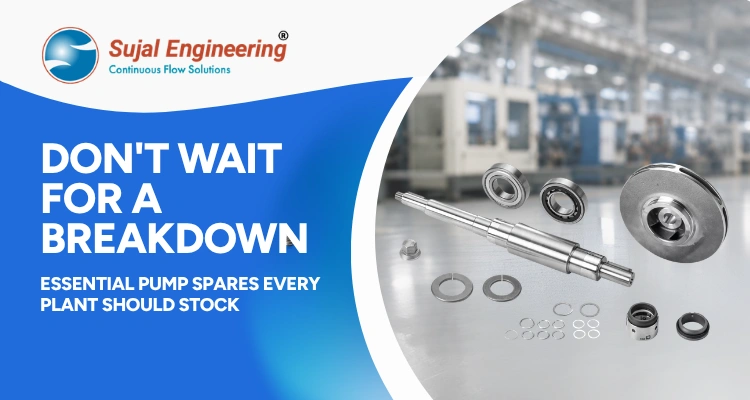
Unplanned pump failure costs plants far more than the price of a replacement part. It costs production hours, missed shipments, and sometimes an entire batch of products. The fastest way to avoid this is simple: stock the right pump spares before you need them, not after a pump has already failed on the floor.
At Sujal Pumps, we work with plant engineers and procurement heads across chemical, pharmaceutical, food and beverage, cement, and wastewater industries every week. The pattern is always the same. Plants that maintain a well-planned spare parts inventory see far less downtime than plants that order parts reactively after a failure. This guide breaks down exactly which pump spares matter most, why they fail, and how to build a stocking plan that keeps your operation running.
Key Takeaways
- Mechanical seals fail first. Seals are the most common source of pump downtime because they operate under constant friction, heat, and chemical exposure.
- Bearings need scheduled replacement, not reactive replacement. Waiting for bearing noise or vibration usually means the shaft or housing has already suffered secondary damage.
- Impellers wear gradually and silently. A worn impeller reduces flow and efficiency long before it triggers an alarm or visible failure.
- Gaskets and O-rings are the cheapest insurance in your plant. They cost little, but their failure can shut down an entire process line.
- Shaft sleeves protect the shaft itself. Replacing a sleeve costs a fraction of replacing a bent or scored shaft.
- Critical spares should be stocked based on lead time, not just cost. A cheap part with a 12-week lead time is more dangerous to your uptime than an expensive part that ships overnight.
- Preventive maintenance schedules cut emergency repair costs significantly. Plants using scheduled part replacement reduce emergency callouts and rush shipping fees.
- Not every pump needs the same spares strategy. Centrifugal, gear, and diaphragm pumps wear differently, so your inventory plan should reflect pump type, not a single generic checklist.
Not Sure Which Spares Your Pump Models Actually Need?
Our team at Sujal Pumps can review your pump fleet and recommend a stocking list tailored to your specific operating conditions, helping you maintain reliable performance and reduce downtime.
Get in Touch with Our TeamWhy Do Pumps Fail Without Warning?
Most pump failures are not sudden. They are the end result of a wear process that started weeks or months earlier and went unnoticed. Seals lose their sealing face, bearings lose lubrication film, impellers erode from abrasive slurry, and by the time a plant notices reduced flow or unusual noise, the damage has already spread to adjacent components.
This is why reactive maintenance is expensive. A single seal failure that could have been a fifteen-minute planned swap turns into a multi-day repair once it damages the shaft, sleeve, or bearing housing around it.
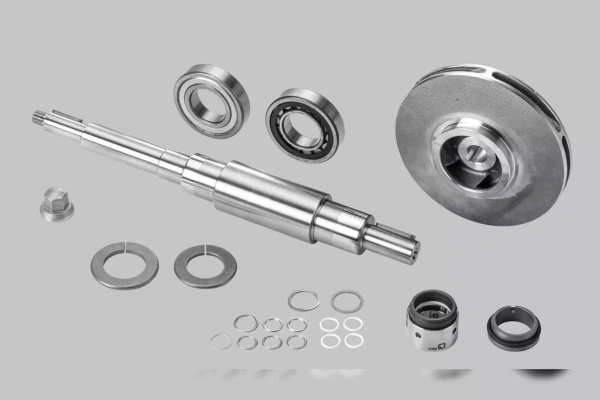
What Are the Most Critical Pump Spare Parts to Stock?
Why Do Mechanical Seals Fail So Often?
Mechanical seals sit at the point of highest stress in a pump. They handle constant rotation, pressure differential, and in many industrial applications, direct exposure to corrosive or abrasive fluids. Dry running, even for a few seconds, can score a seal face permanently.
For plants running centrifugal process pumps continuously, keeping a spare seal kit on hand is one of the highest value investments in your spares inventory. If you want a deeper look at proper seal installation and the failure points to watch, our guide on mechanical seals in centrifugal pumps covers the installation steps in detail.
How Often Should Pump Bearings Be Replaced?
Bearings should follow a scheduled replacement interval based on running hours and operating temperature, not a reactive “replace when it fails” approach. Once a bearing starts generating audible noise or vibration, the shaft and housing tolerances have often already shifted out of spec.
A stocked bearing kit sized to your specific pump model means a scheduled swap takes an afternoon instead of a multi-day plant shutdown while you source the exact bearing from a distributor.
Why Do Impellers Need Regular Inspection?
Impeller wear is one of the sneakiest failure modes in industrial pumping. Erosion from abrasive slurry or cavitation damage reduces the impeller’s clearance and geometry gradually. Flow output drops, energy consumption rises, but nothing looks obviously broken until efficiency has already dropped significantly.
Checking impeller clearance on a fixed schedule catches this before it becomes a bigger repair. Our detailed breakdown on impeller clearance in centrifugal pumps explains exactly what tolerances to check for and how clearance loss affects overall pump output.
Struggling with Unexplained Drops in Pump Output?
Our engineers can inspect your impeller clearance and recommend the right replacement schedule based on your application, helping restore pump efficiency and maintain reliable performance.
Talk to Our TeamWhat Role Do Gaskets and O-Rings Play?
Gaskets and O-rings are the least expensive parts on this list, and also the most overlooked. A cracked gasket at a casing joint or a degraded O-ring at a suction connection can cause a leak that shuts down an entire line, particularly in pharmaceutical and food processing plants where any leak triggers a full contamination review.
Stocking a full set of gaskets and seals sized to your pump models is inexpensive insurance against a disproportionately expensive shutdown.
Why Are Shaft Sleeves Worth Stocking?
A shaft sleeve is a sacrificial component. It protects the pump shaft itself from wear at the packing or seal area. Replacing a worn sleeve costs a small fraction of what it costs to replace or remachine a scored shaft. Plants that skip sleeve replacement often end up paying for shaft repair instead, along with the extended downtime that comes with sourcing and fitting a new shaft.
What Pump Spares Matter Most for Gear Pumps?
Gear pumps used for viscous fluid transfer wear differently than centrifugal pumps. The critical wear parts are the gear sets themselves, bushings, and shaft seals. If your plant runs rotary gear pumps for high viscosity fluid transfer, keeping a spare gear set and bushing kit on hand prevents extended downtime, since these components are often custom machined and carry longer lead times than standard centrifugal pump parts.
Pump Spare Parts Comparison by Pump Type
Pump Type | Highest Wear Component | Typical Failure Cause | Recommended Stock Priority |
Centrifugal Process Pump | Mechanical seal, impeller | Dry running, cavitation, abrasive fluid | High |
Rotary Gear Pump | Gear set, bushings | Viscosity changes, particulate contamination | High |
Self Priming Mud Pump | Wear plates, impeller | Abrasive slurry erosion | High |
Air Operated Diaphragm Pump | Diaphragm, check valves | Chemical incompatibility, fatigue cracking | Medium |
Vertical Long Shaft Sump Pump | Shaft bearings, sleeve | Submersion wear, misalignment | Medium |
How Should Plants Prioritize Which Spares to Stock First?
Not every spare part deserves the same shelf space. The right approach ranks parts by two factors together: how likely the part is to fail, and how long it takes to source a replacement. A part that fails often, but ships overnight is a lower priority than a part that fails rarely but takes twelve weeks to arrive from a specialty manufacturer.
Critical Spares Inventory Checklist
Priority Tier | Criteria | Example Parts | Action |
Tier 1: Critical | High failure frequency, long lead time | Mechanical seals, gear sets, custom bushings | Always in stock, minimum 2 units |
Tier 2: Important | Moderate failure frequency, short to moderate lead time | Bearings, impellers, shaft sleeves | Stock 1 to 2 units, review quarterly |
Tier 3: Standard | Low cost, widely available | Gaskets, O-rings, fasteners | Stock in bulk, low-cost insurance |
Building a Spare Parts Inventory from Scratch?
Creating a reliable spare parts inventory can be challenging without a clear baseline. Our team can help you map your pump fleet against this priority framework and recommend the right stocking strategy for your operations.
Reach Out to Our TeamHow Does Preventive Maintenance Reduce Spare Parts Costs?
Preventive maintenance flips the entire cost equation. Instead of paying rush shipping fees and overtime labor during an emergency repair, a plant on a scheduled maintenance plan replaces wear parts during planned downtime windows, often at a fraction of the cost.
Plants that follow a documented maintenance checklist, inspecting seals, bearings, and impeller clearance on a fixed schedule, consistently report fewer emergency repairs. Our article on the advantages of regular maintenance for industrial pumps walks through exactly how a maintenance schedule reduces failure frequency across pump fleets.
Why Does Shaft Alignment Matter for Spare Parts Longevity?
Poor shaft alignment accelerates wear on nearly every component covered in this guide. A misaligned shaft puts uneven load on bearings, stresses mechanical seals unevenly, and can bend the shaft itself over time. Checking alignment during every scheduled maintenance visit extends the service life of your entire spares inventory. Our guide on pump shaft alignment explains why this single check protects so many downstream components at once.
What Does Downtime Actually Cost a Plant?
The real cost of a pump failure is rarely the spare part itself. It is the production line sitting idle, the batch that has to be scrapped, and the overtime labor required to get the line running again. Our breakdown of the true cost of using the wrong pump shows how selection and maintenance decisions compound over the life of the equipment, and the same logic applies directly to spare parts planning.
For plants running continuous processes, even a few hours of unplanned downtime can outweigh an entire year’s spare parts budget. This is the core argument for stocking ahead of failure rather than reacting to it.
Facing Repeated Pump Downtime from the Same Issue?
If your plant has experienced recurring pump failures and unexpected downtime, our team can help identify the root cause and recommend the right spare parts strategy to improve reliability and prevent repeat breakdowns.
Connect with Our TeamHow Should a Plant Build a Spare Parts Management System?
A functional spares management system needs three things: a documented list of critical parts per pump model, a tracked reorder point for each part based on lead time, and a review cycle that adjusts stock levels as failure data comes in.
Many plants start with a spreadsheet listing every pump, its critical spares, current stock count, and supplier lead time. As the fleet grows, this evolves into a proper CMMS system, but the underlying principle stays the same. You cannot manage what you do not track, and a plant that tracks its spares consistently avoids the scramble of sourcing an obscure part during an active shutdown.
Conclusion
Pump spares are not an expense to minimize. They are insurance against the much larger cost of unplanned downtime, scrapped production, and emergency repair labor. The plants that handle this best are the ones that stock critical wear parts ahead of failure, follow a scheduled maintenance plan, and treat spares inventory as a core part of their reliability strategy rather than an afterthought.
Sujal Pumps has spent decades manufacturing centrifugal, gear, diaphragm, and slurry pumps built for exactly the demanding conditions this guide has covered, from chemical processing to pharmaceutical manufacturing to cement and mining applications. Our team understands which components wear fastest in your specific application because we build the pumps ourselves. If you want help identifying the right spares to stock for your fleet, or you are evaluating a pump replacement altogether, get in touch with our team today.
Frequently Asked Questions
1. What are the most important pump spare parts to keep in stock?
Mechanical seals, bearings, impellers, gaskets, and shaft sleeves cover the majority of common pump failures. Prioritize the ones with the longest supplier lead times first.
2. How often should industrial pumps be serviced?
Service intervals depend on operating hours and fluid conditions, but most industrial pumps benefit from a full inspection every three to six months, with seal and bearing checks on a shorter cycle for continuous duty applications.
3. Why do mechanical seals fail more often than other pump components?
Mechanical seals operate under constant friction and pressure at the point of highest wear in the pump. Dry running, misalignment, and chemical exposure all accelerate seal degradation faster than most other components.
4. How do I know if my pump impeller needs replacement?
A drop in flow rate or pressure output, combined with rising energy consumption, usually signals impeller wear. Physical inspection of the clearance and blade edges confirms whether replacement is needed.
5. What is the difference between preventive and reactive pump maintenance?
Preventive maintenance replaces wear parts on a planned schedule before failure occurs. Reactive maintenance waits until the pump fails, which typically costs more due to emergency labor, expedited shipping, and secondary damage to surrounding components.
6. How much does unplanned pump downtime typically cost a plant?
Costs vary by industry, but unplanned downtime almost always exceeds the cost of the spare part itself once you factor in lost production, scrapped batches, and overtime repair labor.
7. Should every pump in a plant have the same spares stocking strategy?
No. Centrifugal, gear, diaphragm, and slurry pumps wear differently based on their design and the fluids they handle. Your stocking plan should reflect the specific wear patterns of each pump type in your fleet.
8. How do I decide which spare parts to prioritize with a limited budget?
Rank parts by combining failure frequency with supplier lead time. Parts that fail often and take a long time to source should always be stocked first, regardless of unit cost.